



What will my monthly payment really be on a home in Lincoln?
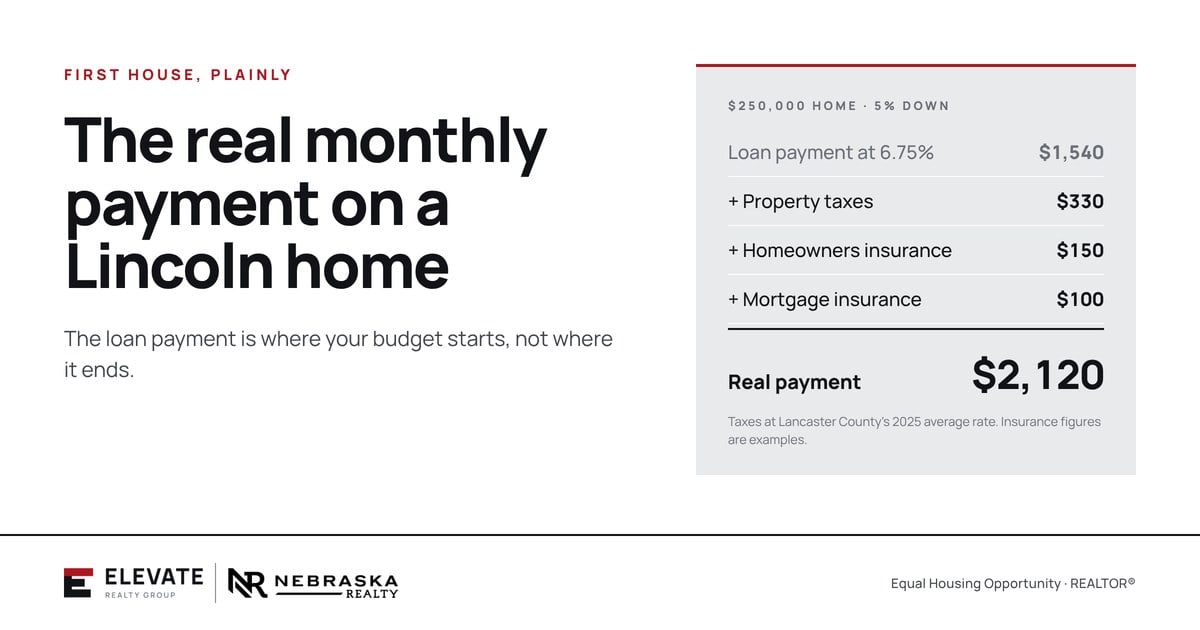
Your real monthly payment is the loan payment plus property taxes, homeowners insurance and, if you put less than 20% down, mortgage insurance. On a $250,000 Lincoln-area home with 5% down, that can turn a $1,540 loan payment into about $2,120 a month. Get the full number from your lender before you start touring, not after you fall for a house.
By Jorin Masley | November 5, 2026
Most first-time buyers I meet have already run a payment. They plugged a price into a calculator, saw a number they could live with and started looking at houses.
Then the lender sends the full estimate, and the number is a few hundred dollars higher than the one they had in their head.
Nothing went wrong. The first number just left things out. Here’s what goes into the real one, with a worked example for a Lincoln-area home.
What goes into your monthly payment
Lenders call the core of it PITI (principal, interest, taxes and insurance). Most calculators show only principal and interest. Here are the pieces, including the one that catches buyers with smaller down payments.
1. Principal and interest. This is the loan payment. It pays back what you borrowed plus the interest. On a fixed-rate loan, this part never changes.
2. Property taxes. In Lancaster County, the average property tax rate was 1.5955% of assessed value in 2025, according to the Nebraska Department of Revenue. On a $250,000 home, that works out to about $3,990 a year, or roughly $330 a month.
3. Homeowners insurance. Your lender requires it, and in Nebraska, hail and wind are a big part of what you pay for. Your premium depends on the home’s roof age and type, your deductible and the coverage you choose.
4. Mortgage insurance. With less than 20% down on a conventional loan, you’ll usually pay PMI (private mortgage insurance). It protects the lender, not you. FHA (Federal Housing Administration) loans have their own version.
On most loans, taxes and insurance go into an escrow account. Your lender collects a little each month and pays those bills for you when they’re due. That’s why they show up in your monthly payment instead of as separate bills.
A Lincoln example, start to finish
Say you’re buying a $250,000 home with 5% down ($12,500). Your loan is $237,500 on a 30-year fixed mortgage.
Here’s how the payment builds:
- Principal and interest: about $1,540 a month at 6.75%. (6.75% is the conventional rate NIFA, the Nebraska Investment Finance Authority, posted on November 5, 2026. Your rate will depend on your loan and credit.)
- Property taxes: about $330 a month, using Lancaster County’s 2025 average rate
- Homeowners insurance: $150 a month in this example. Your quote may come in higher or lower, which is why you get a real one before you’re under contract.
- Mortgage insurance: about $100 a month in this example. Your rate depends on your credit score and down payment.
Real monthly payment: about $2,120.
The calculator said $1,540. The real number is close to $580 more, almost 40% higher. That gap is where a lot of buyers end up feeling house poor.
Why the county number is only a starting point
The 1.5955% rate is an average across all of Lancaster County, including farmland. A home inside Lincoln, Hickman or another town pays the levies for its own city and school district, so the actual bill on the house you’re looking at can be higher or lower.
Rates also differ by county. In 2025, the average was 1.3089% in Saline County (Crete and Wilber) and 1.1232% in Seward County (Seward and Milford). On the same $250,000 home, that’s roughly $270 a month and $235 a month in taxes. Those are county averages too, so the same rule applies: look up the actual bill.
The fix is easy. Look up the home’s most recent tax bill on the county treasurer’s website. That’s the real number, and it takes about two minutes. If the home is new construction, ask what it will be assessed at once it’s finished, because the current bill may only reflect the land.
Two more local details first-time buyers rarely hear about:
- Nebraska property taxes are paid in arrears. In most of the counties we work in, you’ll get a credit at closing for the seller’s share of taxes that haven’t been paid yet. It helps at closing, but the bills still come due later, so your escrow account needs to be funded for them.
- Your payment can change even with a fixed rate. Your lender reviews your escrow account once a year. If your valuation or your insurance premium goes up, your monthly payment goes up with it. Your rate stays the same; the escrow part moves.
How to get your real number before you shop
This is the order I walk every buyer through:
- Ask your lender for a full payment estimate, not just the loan payment. Ask them to show taxes, insurance and mortgage insurance on separate lines.
- Pick a monthly number you can live with, not the most you can be approved for. The approval is a ceiling. Many lenders want your total monthly debts, including the new mortgage, to stay below about 43% of your gross income, according to NIFA. Living at that ceiling leaves very little room for daycare, car repairs or savings.
- Work backward to a price range that keeps the full payment at or under your number.
- Check the real tax bill and get an insurance quote on any home you’re serious about, before your inspection period ends.
If a payment that fits your life puts you below the price you hoped for, it’s better to know that now. A smaller payment you can keep up with will give you more room than a bigger house you can’t relax in.
It’s also worth looking at the things you shouldn’t do while you’re buying, since new debt can change the payment you qualify for. If you’re still deciding whether to buy at all, start with whether renting or buying makes more sense for you.
Frequently asked questions
How much are property taxes on a $250,000 home in Lincoln?
At Lancaster County’s 2025 average rate of 1.5955%, taxes on a $250,000 home come to about $3,990 a year, or roughly $330 a month. The actual bill depends on the city and school district the home is in. Check the home’s last tax bill on the Lancaster County treasurer’s website for the real number.
Does my mortgage payment include homeowners insurance?
Usually, yes. Most lenders collect your insurance and property taxes each month in an escrow account and pay those bills for you. That’s why your full payment is higher than the loan payment alone.
Why did my mortgage payment go up if I have a fixed rate?
The fixed rate only covers principal and interest. Your lender reviews your escrow account once a year, and if your property taxes or insurance premium went up, your monthly payment goes up to cover them.
When does PMI go away?
On a conventional loan, you can ask to remove PMI once you owe 80% of the home’s original value. It ends automatically when you reach 78%. FHA loans follow different rules, so ask your lender how yours works.
Do Crete, Seward and Milford have lower property taxes than Lincoln?
In 2025, the average rate was 1.3089% in Saline County (Crete and Wilber) and 1.1232% in Seward County (Seward and Milford), compared with 1.5955% in Lancaster County. Those are countywide averages that include farmland, so compare the actual tax bills on the homes you’re considering.
The number that matters
The loan payment is where your budget starts, not where it ends. Add taxes, insurance and mortgage insurance before you fall for a house, and you’ll shop with a number you can live with.
If you’re thinking through this for your own situation, I’m happy to walk you through the numbers on a home you’re looking at, or on your budget before you start. Reach out anytime at 402-728-8750 or [email protected].
About Jorin Masley
REALTOR® and Team Lead at Elevate Realty Group, brokered by Nebraska Realty. Leads with clarity: makes the complicated plain and shows you the real numbers early. Serves Lincoln and the surrounding communities of Milford, Seward, Beatrice, Crete, Waverly, Hickman and Roca.
Sources: Nebraska Department of Revenue, 2025 Annual Report, Table 8 (county average tax rates); NIFA posted rates, November 5, 2026. Figures for insurance and mortgage insurance are examples, not quotes.