



How much house can we afford without being house poor?
Start with the monthly payment you can live with while still saving and paying for everything else, not the most a lender will approve. Many lenders want total debts, including the new mortgage, below about 43% of gross income, and Nebraska’s NIFA program allows up to 45%, but those are ceilings, not targets. Work backward from your comfortable payment, including taxes and insurance, to find your price range.

Pick the payment you can live with first, then find the price range that fits it.
By Jorin Masley | November 11, 2026
House poor means your home takes so much of your paycheck that there’s nothing left for savings, repairs or a weekend away. It rarely comes from one bad decision. It comes from shopping at the top of an approval that was never meant to be a budget.
Approval vs. budget
A lender’s approval answers one question: how much will they lend you? Your budget answers a different one: how much can you pay every month and still sleep at night?
Here’s the outer edge. NIFA’s homebuying guide notes that many lenders want your total debts, including the future mortgage, to stay below about 43% of your gross income. NIFA’s own First Home Program allows up to 45% debt-to-income (DTI), or 50% with a credit score of 660 or higher.
Gross income is before taxes, retirement and health insurance come out. That’s why a payment that fits the ratio can still feel tight.
A worked example
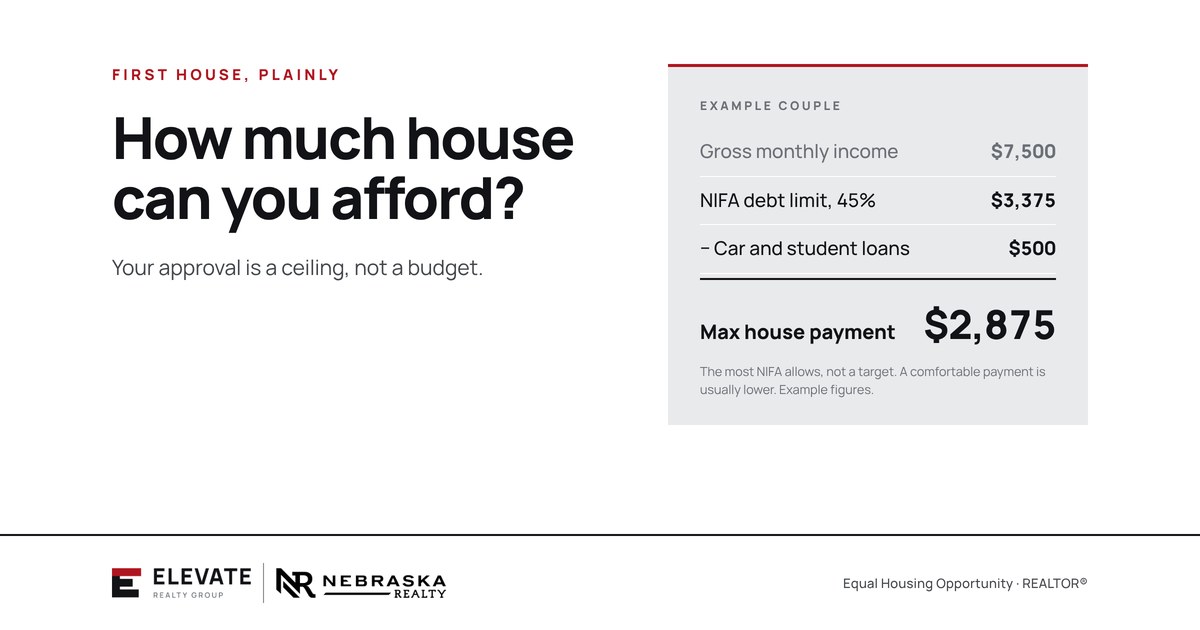
Say a couple earns $90,000 a year combined, or $7,500 a month before taxes. They pay $500 a month for a car and student loans.
- At 43%, total debts could reach about $3,225 a month, leaving about $2,725 for the house payment.
- At 45%, that’s about $3,375 in total debts, leaving about $2,875 for the house.
Now compare that with what actually lands in their checking account each month after taxes, retirement and insurance. If daycare, groceries, gas and savings already take most of it, a $2,875 house payment won’t feel like a home. It’ll feel like a second job.
These numbers are an example, not a quote. Your lender will run your real figures.
Work backward instead
- Pick the payment you’re comfortable with. Start from your take-home pay and real monthly spending, and leave room to save.
- Subtract taxes, insurance and mortgage insurance. In Lancaster County, taxes alone averaged about 1.6% of value in 2025. See what property taxes look like around Lincoln.
- Ask your lender to turn what’s left into a price range at today’s rates.
- Shop at the lower of the two numbers: your comfortable range or your approval.
If that range is lower than you hoped, it’s better to know before you fall for a house. Here’s how the full payment adds up on a typical home: the real monthly payment on a Lincoln home.
Leave room for the first year
Closing costs, moving, a lawn mower, window coverings and the first surprise repair all land in year one. Keep savings after closing so the first broken water heater doesn’t land on a credit card.
Frequently asked questions
How much of my income should go to a house payment?
There’s no single right percentage. Many lenders want total debts below about 43% of gross income, and NIFA allows up to 45%, but a comfortable payment is usually lower once you account for taxes, savings and childcare.
What does house poor mean?
House poor means your housing costs take so much of your income that little is left for savings, repairs or everyday life. It usually happens when buyers shop at the top of their approval instead of a budget.
Does my approval include taxes and insurance?
Lenders count the full payment, including property taxes, homeowners insurance and mortgage insurance, when they calculate what you qualify for. Ask for those on separate lines so you can see each one.
What debt-to-income ratio does NIFA allow?
NIFA’s First Home Program allows a maximum debt-to-income ratio of 45%, or 50% with a credit score of 660 or higher. Lenders and loan types can set stricter limits.
Pick the payment first
The right house is the one you can keep enjoying after the first bill arrives. If you want help working backward from a payment to a price range, I’m happy to sit down and run it with you. Reach out anytime at 402-728-8750 or [email protected].
About Jorin Masley
REALTOR® and Team Lead at Elevate Realty Group, brokered by Nebraska Realty. Leads with clarity: makes the complicated plain and shows you the real numbers early. Serves Lincoln and the surrounding communities of Milford, Seward, Beatrice, Crete, Waverly, Hickman and Roca.
Sources: NIFA, How much house can I afford; NIFA First Home Program, checked November 5, 2026.