



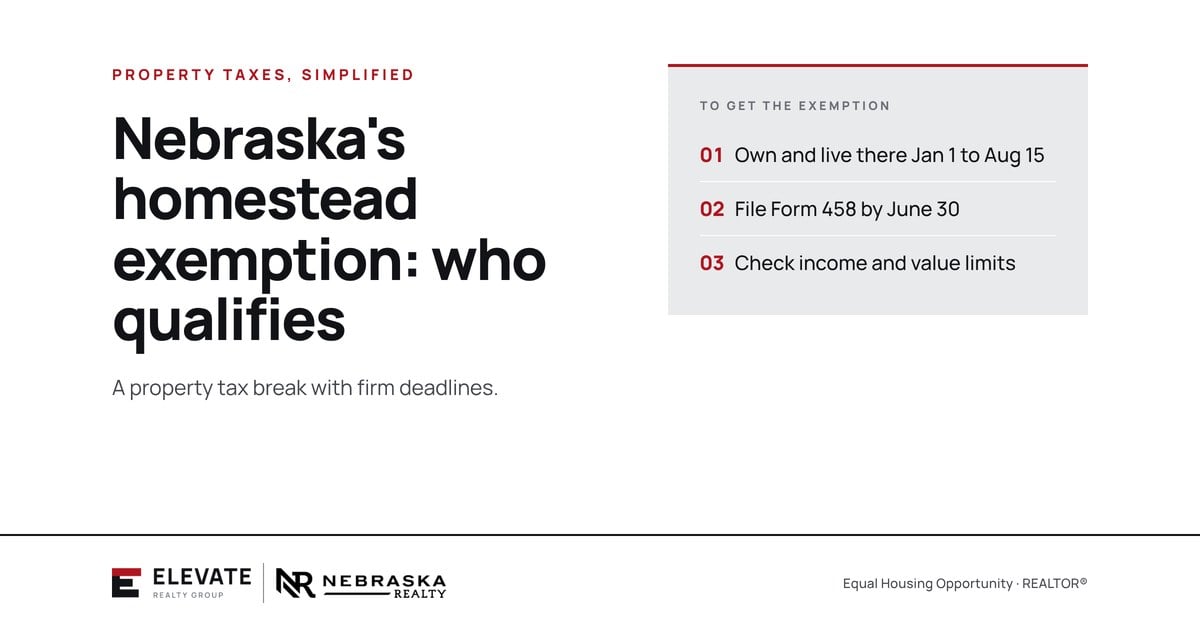
Who qualifies for the Nebraska homestead exemption?
Nebraska’s homestead exemption lowers property taxes for three groups of homeowners: people who are 65 or older before January 1 of the year they apply, qualified disabled individuals and qualified disabled veterans and their surviving spouses. You have to own and live in the home from January 1 through August 15, and you file Form 458 with your county assessor between February and June 30. For the 65-and-older and most disability categories, how much you save depends on your household income and your home’s value.

By Jorin Masley | November 18, 2026
This one comes up a lot when we run the numbers on a purchase. It also comes up when buyers look at a home’s current tax bill and wonder why it’s so low.
The exemption can take a real bite out of a property tax bill. But it has hard deadlines, an income test for most applicants and a value limit that trips people up. Here’s how it works.
Prefer to watch? Here’s the 45-second version.
The three groups that can qualify
The Nebraska Department of Revenue (DOR) lists three groups who can get a homestead exemption:
- Owners 65 or older. You have to turn 65 before January 1 of the year you apply.
- Qualified disabled individuals. This includes people with a qualifying physical disability and people with a developmental disability, under the rules in the DOR guide.
- Qualified disabled veterans and their surviving spouses. This includes veterans with a 100% service-connected disability rating and some surviving spouses.
Inside those groups, the DOR Homestead Exemption Information Guide splits applicants into numbered categories, each with its own paperwork. One detail worth knowing: the guide says receiving Social Security disability doesn’t automatically qualify you. The disability has to meet the program’s own definition.
The exemption doesn’t send you a check. Per the DOR, it exempts all or part of your home’s taxable value, and the state reimburses the counties and other local governments for the taxes they lose.
The home itself has to qualify too
The guide sets a few rules about the property:
- You must own it and live in it from January 1 through August 15 of the year you apply.
- The homestead is the house plus up to one acre of land. On an acreage, the rest of the land is taxed normally.
- It can’t be owned by a business. The guide says homes owned by a corporation, partnership or LLC don’t qualify.
If you’re in the hospital or a care facility for a while and plan to come back, the guide says that absence doesn’t knock you out.
How income and home value change what you save
This is the part most people miss. For the 65-and-older category and the main disability categories, the exemption is on a sliding scale. The guide says there are no income or home value limits for the veteran categories tied to a 100% service-connected disability and their surviving spouses.
The income test
Household income is based on the year before you apply. The guide defines it as your federal adjusted gross income plus certain other income it lists, and you report it on Form 458 Schedule I.
The DOR posts a new income table each year. For 2026, the guide’s table showed:
- Single, 65 or older: household income up to $37,000 got the full exemption. At $54,301 and over, no exemption.
- Married or closely related, 65 or older: up to $43,400 got the full exemption. At $64,501 and over, no exemption.
Incomes in between get a partial exemption. The disability categories have their own, slightly higher limits on the same table. Expect the 2027 numbers to be different, so check the new table when it’s posted.
The home value test
Each county has a maximum home value for the exemption, based on the DOR’s average residential value for that county. According to the guide, if your home is worth more than that maximum, the exemption drops by 10% for every $2,500 over. If your home is $20,000 or more over the maximum, you don’t qualify at all.
That matters when you’re shopping. Two homes at different prices can mean very different tax bills for the same buyer. If the exemption is part of your budget, look at the county’s maximum before you settle on a price range. Our post on property taxes in Lincoln shows how to read a real tax bill, and the real monthly payment on a Lincoln home shows where taxes land in your payment.
When and how to apply
You apply every year with your county assessor, not with the state. Lancaster County’s Important Dates page lists February 1 as the first date to apply and June 30 as the last date to file.
Here’s the process:
- Get the forms. The DOR’s homestead exemption page has Form 458 (the application), Schedule I (the income statement) and Form 458B (the disability certification).
- Gather your income records from the prior year. Schedule I is required for the 65-and-older and main disability categories.
- Get the disability certification if you need it. The guide says Form 458B is required the first year for the physical and developmental disability categories, and again in some later years. Veterans’ categories use a VA certification instead.
- File with your county assessor by June 30. Questions go to the assessor’s office or the DOR Homestead Helpline at 888-475-5101.
Miss June 30 and you’ve generally missed the year. The guide describes a few narrow exceptions, including a county board extension on written request and late filing for certain medical reasons or a spouse’s death. Don’t count on them.
What this means if you’re buying now
If you close on a home this fall or winter and live in it on January 1, your first chance is the 2027 application, due June 30, 2027. You’ll need to own and live in the home from January 1 through August 15, 2027.
Two things to check during your purchase:
- Look at the seller’s tax bill closely. The exemption is tied to the owner’s age or disability, income and occupancy, so a low bill on a seller’s homestead may not be the bill you’ll get. Budget from the full tax amount unless you know you’ll qualify.
- Moving from one homestead to another? The DOR has a transfer form, Form 458T, for owners who move to a new home before August 15. Ask the assessor about it before you close.
The property taxes at closing work separately from all this. Most of our counties pay taxes in arrears, so you’ll usually get a credit from the seller at closing. Our guide to how much cash you need to close walks through that credit.
Frequently asked questions
Who qualifies for the homestead exemption in Nebraska?
Homeowners who are 65 or older before January 1 of the application year, qualified disabled individuals and qualified disabled veterans and their surviving spouses. You also have to own and live in the home from January 1 through August 15 of that year.
When is the Nebraska homestead exemption deadline?
You file Form 458 with your county assessor between February and June 30 each year. Lancaster County lists February 1 as the first date to apply and June 30 as the last date to file.
Is there an income limit for the Nebraska homestead exemption?
Yes, for the 65-and-older and main disability categories. The exemption is on a sliding scale by household income, and the DOR publishes a new income table each year. Veterans with a 100% service-connected disability and their surviving spouses have no income or value limits.
Does my home’s value affect the homestead exemption?
It can. Each county has a maximum value. Above it, the exemption drops 10% for every $2,500 over, and homes $20,000 or more over the maximum don’t qualify, except in the categories with no value limit.
Do I have to apply for the homestead exemption every year?
Most applicants do. Form 458 is an annual application for nearly every category. The DOR guide says veterans with a 100% permanent service-connected disability don’t need to refile each year unless their status changes or it’s their first time applying.
The short version
Nebraska’s homestead exemption can lower property taxes for owners 65 and older and for qualified disabled owners and veterans. Own and live in the home from January 1 through August 15, file with your county assessor by June 30 and check the income table and your county’s value limit first.
If you’re thinking through this for your own move, I’m happy to walk you through how the exemption fits into the numbers on a specific home. Reach out to Elevate Realty Group anytime.
About Jorin Masley
Jorin Masley is a REALTOR® and Team Lead at Elevate Realty Group, brokered by Nebraska Realty. He leads with clarity: he makes the complicated plain and shows you the real numbers early. He serves Lincoln and the surrounding communities of Milford, Seward, Beatrice, Crete, Waverly, Hickman and Roca.