



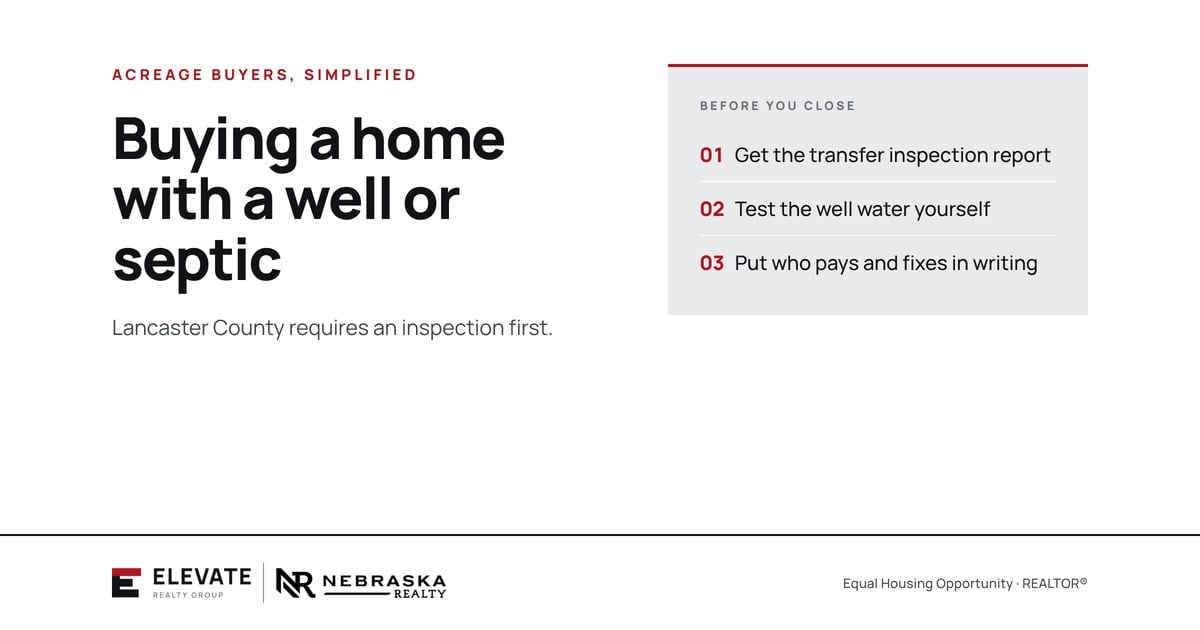
What’s required when you buy a home with a well or septic in Lancaster County?
In Lancaster County, every home served by a private water well or an onsite wastewater (septic) system has to be inspected before it can be sold. The Lincoln-Lancaster County Health Department (LLCHD) requires it, the inspection is done by a private company that holds an LLCHD Property Transfer Inspector permit and the property owner picks and hires that inspector. As the buyer, your job is to get the report, read it and add your own water test if you want more than the minimum.
By Jorin Masley | November 17, 2026
Acreages and homes just outside town are a big part of what we sell around Lincoln. If the home isn’t on city water and sewer, there’s an extra step in the deal, and it surprises a lot of buyers the first time.
The good news: it’s a required step with a clear owner. Here’s how it works, what to ask for and where buyers get tripped up.
Prefer to watch? Here’s the 45-second version.
The Lancaster County rule, in plain terms
The Health Department’s Water Quality page spells it out. All properties with residences served by a private water well or onsite wastewater system must be inspected prior to the sale, transfer or conveyance of the property.
Three details matter for your deal:
- It covers both systems. A home with a well and city sewer, a septic and rural water or both a well and a septic all need the inspection for whichever private system they have.
- Only permitted inspectors can do it. Inspections are done by private companies that hold an LLCHD-issued Property Transfer Inspector permit. The Health Department posts the current list of permitted inspectors on that same page.
- The owner hires the inspector. The page says the property owner selects and contracts with the inspector. When you’re buying, that’s usually the seller, so the report should come to you as part of the transaction.
Questions about the program go to the Health Department’s property transfer line at 402-441-8031.
What the rule doesn’t spell out
The county page doesn’t say who pays for the inspection, how long a report stays good or what happens when something fails. That’s where your purchase agreement and your agent come in. Before you sign, make sure the agreement answers:
- Who orders and pays for the transfer inspection, and the date it has to be done by
- When you get a copy of the report, ideally before your own inspection deadline passes
- What happens if a system fails: repair before closing, a credit, a price change or your right to cancel
If the home is in Saline or Seward County, this Lancaster County rule doesn’t automatically carry over. Ask your agent what that county requires and plan your own testing either way.
What to do as the buyer
1. Ask for the transfer inspection report early
Ask for the report as soon as you’re under contract, or before you write the offer if the seller already has it. Read the whole thing, not just the summary line. Look for notes on the well’s construction and location, the condition of the septic tank and drain field and any repairs the inspector recommends.
Don’t be shy about asking the inspector or the seller what was and wasn’t checked. The county page doesn’t list what a transfer inspection includes, so the report itself is your best guide.
2. Get the water tested for your own peace of mind
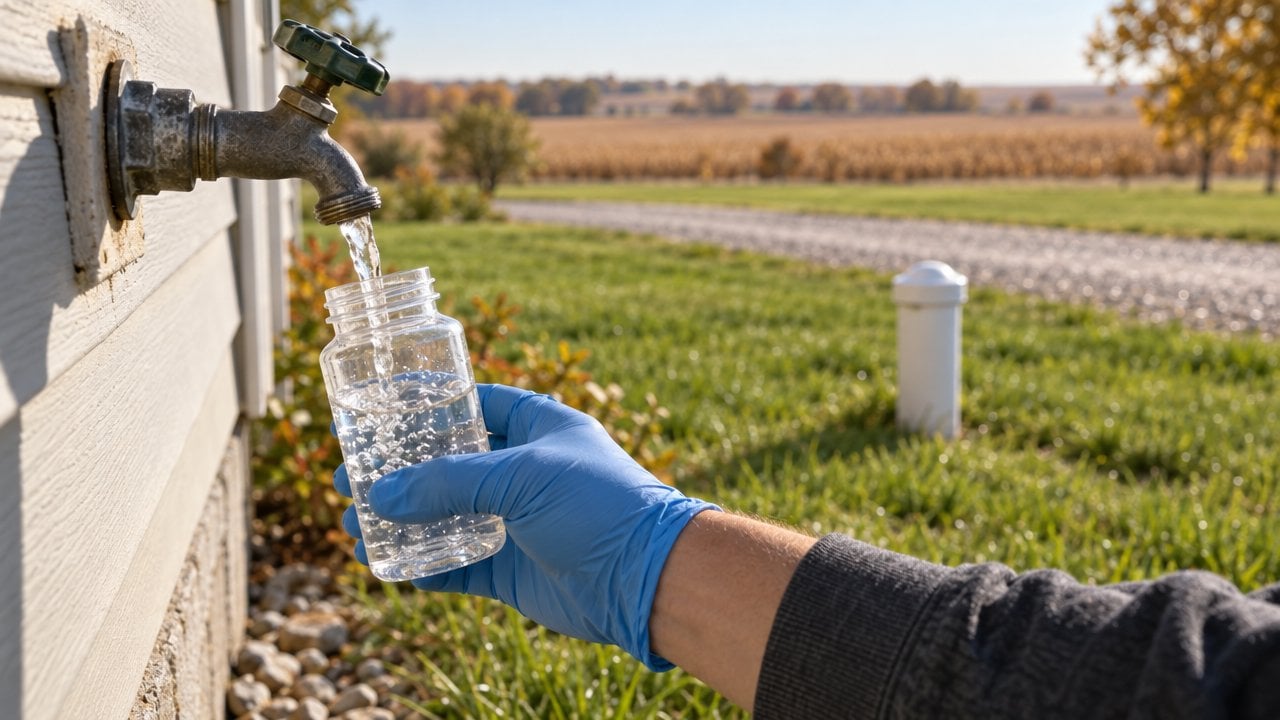
The transfer inspection is the legal minimum. Your drinking water is worth its own test.
Nebraska’s Department of Water, Environment and Energy (DWEE) recommends testing private wells for coliform bacteria and nitrate. Its well testing guide says that when nitrate is above 10 milligrams per liter (mg/L), the water is not safe for infants or for anyone pregnant or nursing to drink. The same guide notes that the state Department of Health and Human Services (DHHS) Public Health Environmental Lab tests water for a nominal fee.
Two things to know:
- Private wells are on you after closing. DWEE recommends testing every year and is clear that this isn’t a requirement, because the state doesn’t regulate private wells. Nobody will remind you.
- A bad result isn’t always a bad well. The DWEE guide lists the well, pressure tank, treatment equipment, plumbing and even faucet filters as possible sources of bacteria. Retesting and a visit from a well professional usually sort it out.
3. Treat the septic like a big system, because it is
A septic system is a lot like a roof or a furnace: invisible on a showing, expensive when it needs work. While you’re in your inspection period, ask the seller for:
- Pumping and repair records, and the date the tank was last pumped
- Where the tank and drain field are on the lot
- Any permits or records for work done on the system
The state’s onsite wastewater program says anyone doing work on these systems has to be certified by the State of Nebraska, and systems that are built, rebuilt or altered must be registered with DWEE. If repairs come up, make sure a certified professional does them and that you get the paperwork.
Our post on what a Lincoln home inspection covers and what to add goes deeper on add-on inspections like radon and sewer scopes. A standard home inspection doesn’t replace the well and septic transfer inspection, and the transfer inspection doesn’t replace a full home inspection.
4. Build the timeline into your offer
Acreage deals have more moving parts. A transfer inspection, a water test and possibly a septic repair all have to fit inside your contract dates. Give yourself room in the inspection period, and don’t let your deadline pass while you’re still waiting on a lab result.
If something big turns up, you have the same options as with any inspection problem: ask for a repair, ask for a credit, renegotiate the price or walk away if your contract allows it. Our guide to what happens when the inspection finds problems walks through each one, and when to walk away after the inspection covers the hard calls.
One state program buyers ask about
You may run across Nebraska’s Well and Septic Loan Evaluation Program in older articles. DWEE’s program page says the state will no longer provide it effective July 18, 2026. It isn’t accepting new applications. Don’t plan your deal around it.
The county transfer inspection is a separate requirement and still applies.
Frequently asked questions
Is a well and septic inspection required to sell a home in Lancaster County?
Yes. The Lincoln-Lancaster County Health Department requires every property with a residence served by a private water well or onsite wastewater system to be inspected before it’s sold or transferred. The inspection must be done by a company with an LLCHD Property Transfer Inspector permit.
Who hires the well and septic inspector?
The property owner selects and contracts with the permitted inspector, according to the Health Department. In a sale, that’s usually the seller. Who pays isn’t set by the county, so spell it out in your purchase agreement.
Should I test the well water even if the transfer inspection passed?
It’s a good idea. Nebraska’s DWEE recommends testing private wells for coliform bacteria and nitrate, and it says water above 10 mg/L of nitrate isn’t safe for infants or anyone pregnant or nursing to drink. After you own the home, testing is up to you.
Who do I call with questions about the Lancaster County transfer inspection?
The Lincoln-Lancaster County Health Department’s property transfer line is 402-441-8031. Its Water Quality page also lists the currently permitted inspectors.
Is Nebraska’s Well and Septic Loan Evaluation Program still available?
No. DWEE says the state will no longer provide the program effective July 18, 2026. The Lancaster County transfer inspection is separate and still required.
The short version
In Lancaster County, a home with a private well or septic can’t change hands without an inspection by a permitted inspector, hired by the owner. Get the report early, test the water yourself and put who pays and what happens if something fails in writing.
If you’re looking at an acreage or a home outside city services, I’m happy to walk you through the timeline and what to put in your offer. Reach out to Elevate Realty Group anytime.
About Jorin Masley
Jorin Masley is a REALTOR® and Team Lead at Elevate Realty Group, brokered by Nebraska Realty. He leads with clarity: he makes the complicated plain and shows you the real numbers early. He serves Lincoln and the surrounding communities of Milford, Seward, Beatrice, Crete, Waverly, Hickman and Roca.