



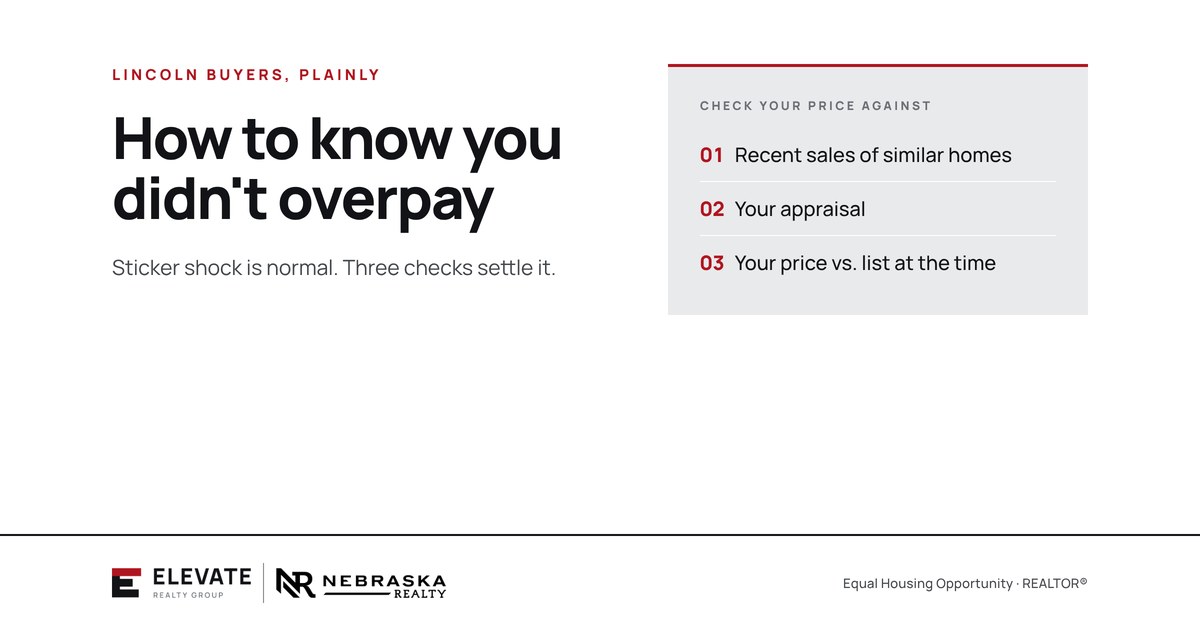
How do you know you didn’t overpay for your home?
Compare what you paid with what similar homes near you actually sold for in the last few months, then check your appraisal. If recent comparable sales back up your price and the appraisal came in at or above it, you paid market value, even if it felt high. For context, Lancaster County homes sold for 98.9% of their final list price on average from January through September 2026, so paying close to list is normal here.

By Jorin Masley | November 16, 2026
Almost every buyer asks me some version of this, usually a few weeks after closing. The keys are in your pocket, a house down the street lists for less and the doubt kicks in.
Here’s the honest answer: “overpaid” has a real definition, and you can check it. It isn’t about whether the price felt big or whether a website shows a lower number. It’s about what buyers were paying for homes like yours at the time you bought.
Three checks that answer the question
1. Recent sales of similar homes
This is the check that matters most. Pull the homes that sold (not just listed) near yours in the few months before your offer. The closer the match, the better:
- Same general area, ideally the same subdivision or a few blocks away
- Similar size and layout: square footage, bedrooms, bathrooms and finished basement
- Similar age and condition, including big-ticket items like the roof, furnace and windows
- Similar lot and garage
Then adjust for differences. If your home has a three-car garage and a new roof and the comparable sale didn’t, your home should be worth more. If the comparable sale had an updated kitchen and yours didn’t, the reverse.
A word on price per square foot: it’s a quick gut check, not an answer. A 1,400-square-foot ranch and a 2,800-square-foot two-story on the same street won’t sell at the same price per foot, and finished basement space usually doesn’t count the same as space above ground.
If you bought with us, ask and we’ll pull an updated set of comparable sales for your home.
2. Your appraisal
If you used a mortgage, a licensed appraiser gave the lender an opinion of what the home is worth. The Consumer Financial Protection Bureau (CFPB) describes an appraisal as an independent assessment of the value of the property.
You’re entitled to see it. For a first-lien mortgage, the CFPB says you have the right to a free copy of your home appraisal, sent promptly after it’s completed and no later than three days before your loan closes. If you never opened it, dig it out of your closing paperwork or ask your lender.
What to look for:
- The final value. At or above your price is a strong sign you paid market value.
- The comparable sales the appraiser used. Are they really like your home? Are they recent?
- The adjustments. The appraiser adds or subtracts for differences in size, condition and features. This shows you how the number was built.
If you’re still before closing and the appraisal came in below your price, that’s a different conversation: your appraisal contingency, your lender and your agent all come into play. Talk to your agent before any deadline passes. If you think the appraiser missed better comparable sales, ask your lender how to request a review and send the sales you think were left out.
3. How your price compared with the market at the time
The third check is context. How did your price compare with the list price, and how fast was the home likely to sell?
Here’s what the Lancaster County numbers looked like in 2026, from the Great Plains REALTORS® multiple listing service (MLS) data we pull for our market reports:
- Sale-to-list price: homes sold for 98.9% of their final list price on average from January through September 2026.*
- Days on market: homes that sold from July through September 2026 had a median of 8 days on market and an average of 20.*
Example only: on a home listed at $320,000, 98.9% of list works out to about $316,500. Paying full list price, or a little over on a home that drew several offers in its first weekend, is not overpaying in a market like that. That’s what the home was worth to the buyers competing for it.
Where a closer look makes sense: you paid well over list on a home that had been sitting for weeks, or you paid list for a home that needed work the price didn’t reflect.
*Source: Great Plains REALTORS® MLS, Lancaster County residential sales, pulled October 21, 2026. Sale-to-list uses the final list price, not the original, and relisted homes reset their days on market, so true time to sell runs a bit longer.
What doesn’t tell you much
- Online home value estimates. They’re computer models built from public records. They can miss a remodel, a finished basement or a worn-out roof, and they often swing from month to month.
- Your county assessed value. Lancaster County sets assessed values as of January 1 at 12:01 a.m. each year, so it can trail what buyers paid during the year. If you think it’s off, the county lists June 1 to 30 as the window to file a valuation protest. Our post on property taxes in Lincoln explains how that value turns into your tax bill.
- One lower listing down the street. A list price is an ask. Wait to see what it sells for, and check whether it’s truly the same kind of home.
- What a friend paid three years ago. Prices and rates move. The only fair comparison is what buyers paid around the time you bought.
If you think you did pay too much
First, take a breath. Paying a bit above where the comparable sales landed only costs you real money if you have to sell soon. Over the years you own a home, a few thousand dollars on the purchase price usually matters a lot less than your monthly payment.
Here’s what I’d focus on instead:
- Know your real monthly cost. Your payment includes taxes and insurance, not just the loan. Our guide to the real monthly payment on a Lincoln home breaks it down.
- Plan to stay a while. Selling costs money. The longer you stay, the more time the home has to catch up.
- Spend on upkeep before upgrades. A sound roof and mechanicals protect value. Not every remodel pays you back.
- Watch your valuation notice. If the county’s value on your home climbs above what similar homes are selling for, that’s when a protest is worth looking at.
And if you’re still shopping, this is the time to get it right. Know your budget before you fall in love (start with how much house you can afford without being house poor), and ask to see the sold comparable sales before you write an offer, not after.
Every home and every street is a little different. That’s why the most useful answer comes from looking at the actual sales around your house, side by side.
Frequently asked questions
How do I know if I overpaid for my house?
Compare your price with what similar nearby homes sold for in the few months before you bought, adjusting for size, condition and features. If those sales and your appraisal support your price, you paid market value. Online estimates and assessed values are rough guides, not proof.
Does a low online estimate mean I overpaid?
Not on its own. Automated estimates are built from public records and can miss updates, finished basements or condition issues. Recent comparable sales are a far better measure.
Can I get a copy of my appraisal?
Yes. For a first-lien mortgage, the CFPB says lenders must give you a free copy of the appraisal promptly after it’s completed and no later than three days before your loan closes. Ask your lender if you can’t find it.
Is paying list price overpaying in Lincoln?
Usually not. Lancaster County homes sold for 98.9% of their final list price on average from January through September 2026, according to Great Plains REALTORS® MLS data. Paying list on a well-priced home that’s drawing interest is normal.
What if my assessed value is lower than what I paid?
That’s common. Lancaster County sets values as of January 1, so the assessed value can trail recent sale prices. It doesn’t mean you overpaid.
The short version
You didn’t overpay if recent sales of similar homes and your appraisal support your price. Feeling a little sticker shock is normal. The facts usually settle it.
If you want a second look at your purchase, or you’re about to make an offer and want to see the real comparable sales first, I’m happy to walk you through the numbers. Reach out to Elevate Realty Group anytime.
About Jorin Masley
Jorin Masley is a REALTOR® and Team Lead at Elevate Realty Group, brokered by Nebraska Realty. He leads with clarity: he makes the complicated plain and shows you the real numbers early. He serves Lincoln and the surrounding communities of Milford, Seward, Beatrice, Crete, Waverly, Hickman and Roca.