



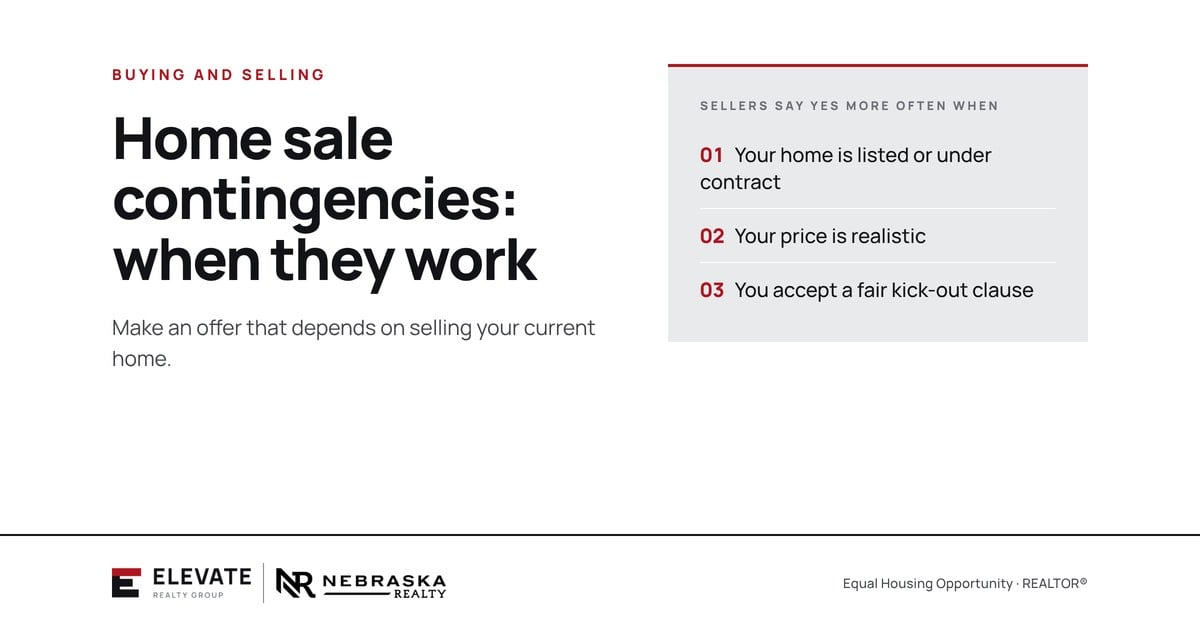
Can you make an offer that depends on selling your current house?
Yes. A home sale contingency lets you make an offer that only goes through if your current home sells first, and if it doesn’t sell in time, you can usually step away without buying two houses. It works best when the seller has time and few other offers, and when your home is already listed or under contract. Expect most sellers to ask for a kick-out clause, which gives you a short window to drop the contingency if a stronger offer shows up.

By Cassi Ohlin | November 15, 2026
This is one of the first questions I hear from people who already own a home. You’ve found the next one. You can’t carry two mortgages. And you’re scared of selling and having nowhere to go.
A home sale contingency is the tool built for exactly that spot. It isn’t a magic key, though. Some sellers will say yes to it and some will say no. How you write it decides a lot.
Here’s how it works, when it’s worth asking for and how to make it as easy as possible for a seller to accept.
How a home sale contingency works
Your offer says, in plain terms: “I’ll buy your house if I sell mine by a certain date.”
That date matters. Terms are negotiable, but Redfin’s guide says a home sale contingency typically lasts 30 to 60 days. During that window you list and sell your home. If it sells, both deals move toward closing. If it doesn’t, a few things can happen:
- The deal ends. You walk away under the contingency. Whether your earnest money comes back depends on how your purchase agreement is written, so read that part with us before you sign.
- You ask for more time. The seller can agree to an extension or say no.
- You move ahead anyway. If you can qualify without the sale, you can drop the contingency and keep going.
There are really two versions of this question:
- Your home is already under contract. You’re waiting on your buyer to close. Sellers see this as much less risky, because the hard part (finding a buyer) is done.
- Your home isn’t listed yet. The seller is betting you’ll find a buyer at the right price in time. That’s a bigger ask, and sellers price that risk into their answer.
If you’re still deciding which order to do things in, start with our guide on whether to buy first or sell first. This post picks up once you’ve decided to write an offer before your house sells.
The kick-out clause: what sellers usually ask for
Most sellers who accept a sale contingency don’t want to stop marketing their home. So they add a kick-out clause.
Here’s how it plays out. The seller keeps the home on the market. If another buyer makes an acceptable offer, the seller notifies you in writing. You then have a short window to either drop your contingency and move forward, or step aside. Zillow describes that window as typically 48 to 72 hours.
That clause isn’t a bad sign. It’s often the reason a seller says yes at all. But it means you need a plan before you sign:
- Know your backup. Could you close without your sale if you had to, with savings, a bridge loan or a home equity line? Ask your lender now, not during a 72-hour scramble.
- Know your ceiling. Two payments for a few months might be doable. Two payments for six months might not. Being approved isn’t the same as being comfortable, and this is where that difference shows up.
- Know your timeline. The clock in the clause is usually short and specific. Put it on your calendar the day you sign.
When a sale contingency works (and when it doesn’t)
A contingent offer competes against offers without one. Redfin is direct about it: in a seller’s market, contingent offers are more likely to be rejected. Zillow notes the offers with the fewest contingencies tend to have an edge.
So the question isn’t “Is a contingency allowed?” It’s “Will this seller, on this house, right now, take it?”
It tends to work when
- The home has been on the market a while and the seller isn’t juggling other offers
- Your home is already under contract or listed and showing well
- Your price is realistic and backed by a recent look at what similar homes sold for
- The seller isn’t in a rush or is buying their own next home on a flexible timeline
- Your offer is otherwise clean: strong pre-approval, a reasonable closing date and no extra asks
It tends to struggle when
- The home is new to the market and drawing several offers
- Your home isn’t listed yet and still needs work before photos
- The seller has a hard deadline, like a job start date or their own closing
- The offer stacks contingencies, for example a sale contingency plus a long inspection period plus repair requests
How to make your contingent offer stronger
You can’t remove the risk for the seller. You can shrink it. Here’s what we do with our clients before we write a contingent offer:
- List your home first, or at least get it ready. A home that’s photographed, priced and showing tells the seller you’re serious.
- Price your current home to sell. An overpriced listing quietly sinks both deals. A clear look at recent sales near you is worth more than a hopeful number.
- Get fully pre-approved, with and without your sale. If your lender can show you’d qualify even if your home takes longer, say so.
- Keep the window short and realistic. A tight, believable date beats an open-ended one.
- Accept a fair kick-out clause. Offering it up front can be the reason your offer wins.
- Keep everything else simple. Fewer extra asks makes the contingency easier to say yes to.
And plan your cash. Both closings move money, and the timing of your sale decides what you’ll have on hand. Our post on how much cash you need to close walks through each piece.
Every situation here is personal: your equity, your loan, the seller’s timeline and how fast homes like yours are selling right now. That’s the part we sort out together before an offer ever goes in.
Frequently asked questions
What is a home sale contingency?
A home sale contingency makes your purchase depend on selling your current home by a set date. If your home doesn’t sell in time, you can usually cancel without buying the new one. The exact terms, including what happens to your earnest money, are written into your purchase agreement.
How long does a home sale contingency last?
It’s negotiable. Redfin’s guide says a home sale contingency typically lasts 30 to 60 days. A shorter, realistic window is easier for a seller to accept.
What is a kick-out clause?
A kick-out clause lets the seller keep marketing the home after accepting your contingent offer. If a better offer comes in, you get a short window, typically 48 to 72 hours, to drop your contingency and move forward or step aside.
Will a seller accept an offer contingent on my home selling?
Some will. It’s most likely when the home has been on the market a while, there are few competing offers and your home is already listed or under contract. In a busy market, sellers often choose offers without contingencies.
Is it better if my home is already under contract?
Yes. An offer that depends on a home already under contract is much less risky for the seller, because you’ve already found a buyer. Many sellers treat it very differently from a home that isn’t listed yet.
The short version
A home sale contingency protects you from owning two homes, and it works best when your house is ready to sell, your price is realistic and you have a plan for the kick-out window.
If you’re thinking through this for your own move, I’d love to walk you through how it would look with your home and the one you’re eyeing. Reach out to Elevate Realty Group anytime.
About Cassi Ohlin
Cassi Ohlin is a REALTOR® and Team Lead at Elevate Realty Group, brokered by Nebraska Realty. She leads with warmth: she makes you feel like the only person in the room. She’s based in Milford and serves Lincoln and the surrounding communities of Milford, Seward, Beatrice, Crete, Waverly, Hickman and Roca.