



Why did my mortgage payment go up if my rate is fixed?
A fixed rate locks your principal and interest, not your whole payment. If your lender collects property taxes and homeowners insurance through an escrow account, your payment moves when those bills move. Once a year your servicer runs an escrow analysis, resets the monthly escrow amount to match the new bills and can spread any shortage over 12 months or more. That is why a payment can jump even though your rate never changed.

By Jorin Masley | November 19, 2026
I get this text every year, usually with a screenshot of the new payment and a lot of question marks. The rate didn’t change. The loan didn’t change. So why is the payment higher?
Almost every time, the answer is in the escrow account. Here’s how it works, how to read the letter your servicer sent and what you can do about it.
Prefer to watch? Here’s the 42-second version.
https://www.youtube.com/watch?v=oZD5WAqBm4o
Your payment has two parts, and only one is fixed
Most monthly mortgage payments are really two payments in one envelope:
- Principal and interest. On a fixed-rate loan, this part stays the same for the life of the loan.
- Escrow. This is money your servicer collects each month and holds to pay your property taxes and homeowners insurance when those bills come due.
The Consumer Financial Protection Bureau (CFPB) puts it plainly: if your payment includes escrow, your payment goes up or down when your taxes or insurance premiums go up or down. That’s the most common reason on its list.
If you want to see how big that escrow piece is on a typical Lincoln home, our post on the real monthly payment on a Lincoln home builds one from scratch.
The other reasons a payment can change
Escrow isn’t the only cause. The CFPB also lists:
- A temporary buydown ending. Buydowns usually last one to three years, and the payment steps up each year until it ends.
- An adjustable-rate loan you thought was fixed. The CFPB says some owners believe their loan is fixed when it has an adjustable feature. Check your loan documents.
- An interest-only period ending, when principal payments start.
- A change in private mortgage insurance (PMI).
- New fees from your servicer.
- A servicer mistake. It happens.
If you have a standard 30-year fixed loan with no buydown, it’s almost certainly escrow.
How the annual escrow analysis works
The rules for escrow accounts come from a federal regulation, Regulation X, section 1024.17, under the Real Estate Settlement Procedures Act (RESPA). The parts that matter for your payment:
- Your servicer reviews the account once a year. At the end of each 12-month escrow year, it has to run an escrow analysis and set your escrow payment for the next year.
- The monthly amount is one-twelfth of the year’s bills. Your servicer can collect 1/12 of the taxes and insurance it expects to pay, plus a cushion.
- The cushion is capped. It can’t be more than one-sixth of the year’s estimated bills, which works out to about two months of escrow payments.
- You get a statement. The servicer has to send an annual escrow account statement within 30 days of the end of the escrow year. It shows what came in, what went out and your new payment.
Shortages: the part that stings
When your taxes or insurance went up during the year, the account paid out more than it collected. That gap is a shortage. Under the regulation:
- If the shortage is one month’s escrow payment or more, the servicer can leave it alone or have you repay it in equal monthly payments over at least 12 months.
- If it’s less than one month’s escrow payment, the servicer can leave it alone, ask you to repay it within 30 days or spread it over at least 12 months.
That’s why the jump can feel bigger than the tax or insurance increase itself. You’re paying for the higher bills going forward and catching up on last year’s gap at the same time.
An example with round numbers
This is an example, not a quote for any real home:
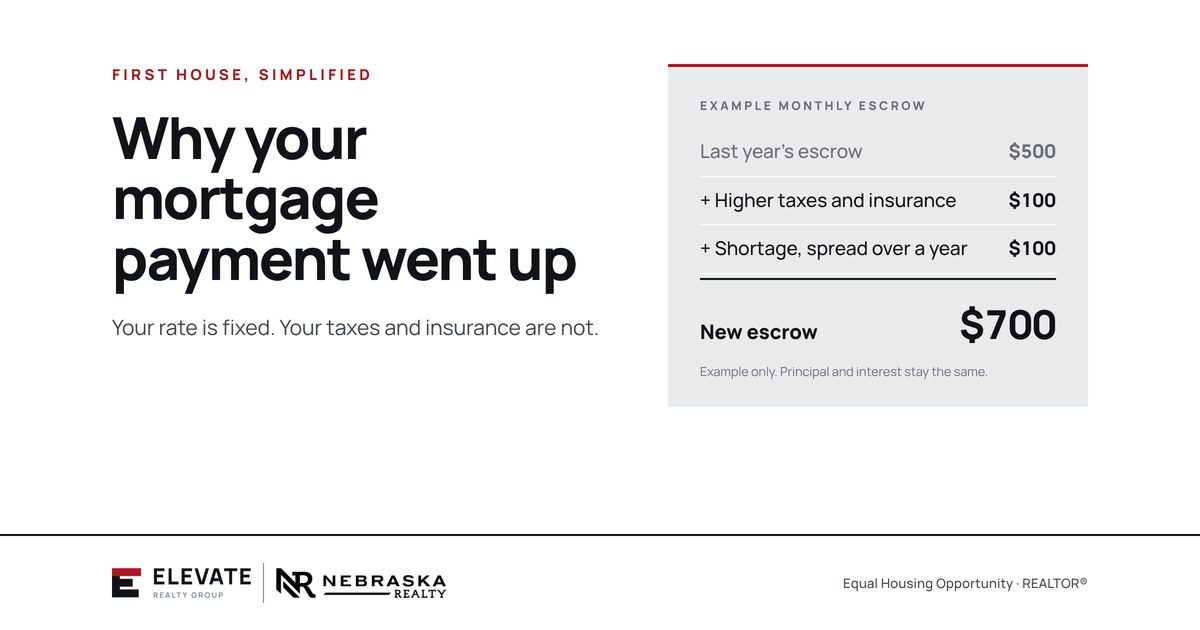
- Last year your escrow was $500 a month, based on $6,000 a year in taxes and insurance.
- Your tax bill went up $600 and your insurance renewal went up $600. The account paid out $7,200.
- Your new escrow payment for the coming year is $7,200 divided by 12, or $600 a month.
- The account came up about $1,200 short. Spread over 12 months, that’s another $100 a month.
Your payment goes up $200 a month, even though the bills only rose $100 a month. If nothing else changes, the $100 catch-up drops off after a year. The example leaves out the cushion, which can add a little more when the bills grow.
Surpluses work the other way
If the account collected more than it needed, that’s a surplus. The regulation says that if you’re current on your payments and the surplus is $50 or more, the servicer has to refund it within 30 days of the analysis. Under $50, it can refund it or credit it toward next year.
Why new owners get hit hardest
The first year after you buy is when surprises are most common. When the servicer doesn’t know next year’s bill yet, the regulation lets it estimate from the prior year’s charge. That prior bill was the seller’s bill, and it may not look like yours:
- The seller had an exemption you don’t. A seller who qualified for Nebraska’s homestead exemption may have had a much lower bill. Our post on who qualifies for the homestead exemption explains why that bill doesn’t carry over to you.
- The home was new construction. The regulation lets the servicer estimate unassessed new construction from comparable homes, but the first full assessment can still land higher than the estimate.
- The valuation changed. In Lancaster County, the Important Dates page lists June 1 as the last date for the assessor to notify owners of a valuation increase or decrease.
- Your insurance renewed higher. Our post on why Nebraska homeowners insurance costs so much covers roofs, deductibles and coverage choices that drive the price.
Most of our counties also pay property taxes in arrears, so you usually get a credit from the seller at closing for taxes that weren’t paid yet. That credit is handled at closing and doesn’t fix your escrow payment going forward. When we run the numbers on a purchase, I budget from the full tax amount the home will carry for you, not the seller’s bill.
What to do when your payment goes up
- Read the escrow statement line by line. Compare last year’s tax and insurance payments with this year’s projection. The increase should trace back to one of them, plus any shortage.
- Check the shortage math. See whether the shortage is being spread over 12 months or more, and whether the new monthly escrow amount matches the new bills.
- Ask about paying the shortage in one payment. Ask your servicer whether you can pay it off at once instead of carrying it in your monthly payment for a year.
- Look at the bills themselves. Shop your homeowners insurance if the renewal jumped. If you think your valuation is too high, Lancaster County lists June 1 to 30 as the window to file a protest with the county Board of Equalization.
- Dispute an error in writing. If something doesn’t add up, the CFPB says to call your servicer first, then send a written notice of error to the address the servicer uses for errors and information requests.
If the problem still isn’t fixed, the CFPB takes complaints online or at 855-411-2372.
Frequently asked questions
Can my mortgage payment go up if I have a fixed rate?
Yes. A fixed rate only locks principal and interest. If your payment includes escrow for property taxes and homeowners insurance, your payment rises when those bills rise.
How often does my escrow payment change?
Your servicer has to analyze your escrow account at the end of each 12-month escrow year and send you an annual statement within 30 days. The payment can also change after a servicing transfer or if the servicer runs an extra analysis during the year.
What is an escrow shortage?
It’s the amount your escrow account falls short of what it needs at the annual analysis, usually because taxes or insurance went up. If the shortage is one month’s escrow payment or more, the servicer can leave it or spread it over at least 12 monthly payments.
Will I get money back if my taxes go down?
If the analysis shows a surplus of $50 or more and you’re current on your payments, the servicer has to refund it within 30 days. Smaller surpluses can be refunded or credited to next year.
Why did my payment go up after my first year in the house?
The first-year escrow is often based on the seller’s prior tax bill. If the seller had an exemption, the home was newly built or the valuation changed, your real bill can come in higher, and the first annual analysis catches up on the difference.
The short version
A fixed-rate payment can still go up because property taxes and homeowners insurance run through escrow. Once a year your servicer resets the escrow amount and can spread any shortage over 12 months or more. Read the escrow statement, check the bills behind it and question anything that doesn’t add up.
If you’re thinking through this for your own situation, I’m happy to walk you through the numbers. Reach out to Elevate Realty Group anytime.
About Jorin Masley
Jorin Masley is a REALTOR® and Team Lead at Elevate Realty Group, brokered by Nebraska Realty. He leads with clarity: he makes the complicated plain and shows you the real numbers early. He serves Lincoln and the surrounding communities of Milford, Seward, Beatrice, Crete, Waverly, Hickman and Roca.