



Rates dropped after I locked my mortgage. Can I still get the lower rate?
Sometimes. A rate lock protects you if rates go up, but it usually holds you to your locked rate if they go down. You have three real options: a float-down if your lock agreement includes one, asking your lender to reprice or relock and switching lenders. Switching can cost time and fees close to your closing date. Small drops are often not worth chasing, so run the math before you ask.

By Jorin Masley | November 24, 2026
You did the responsible thing. You locked your rate so a jump wouldn’t wreck your budget. Then rates slid for a month straight.
That happened this fall. Freddie Mac’s weekly 30-year average was 7.18% on November 5, 2026, down from 7.24% the week before, and then 7.11% on November 12, its fourth weekly decline in a row. If you locked in October, you’re probably wondering whether you left money on the table. Here’s how to find out and what you can actually do about it.
What your rate lock actually promises
The Consumer Financial Protection Bureau (CFPB) defines a rate lock as a promise that your interest rate won’t change between the offer and closing, as long as you close within the lock period and nothing changes on your application. It says locks typically run 30, 45 or 60 days and sometimes longer.
The same page is plain about the trade-off: a rate lock may lock you out of a lower rate if rates fall after you get your loan offer. The lock is insurance against rates rising. It isn’t a promise to give you the lowest rate between now and closing.
Two other things from that CFPB page matter here:
- Your locked rate can still change if your application changes, including your loan amount, credit score or verified income.
- Extensions can be expensive if your closing gets pushed past the lock date.
To see what you have, check the top of page 1 of your Loan Estimate. The CFPB says that’s where it shows whether your rate is locked and for how long. Then find your written lock agreement or lock confirmation from your lender. That document, not the Loan Estimate, is where a float-down or repricing policy would be spelled out.
Your three options when rates drop after you lock
1. Use a float-down, if you have one
A float-down is an add-on some lenders include in a lock agreement. Chase describes it as a feature that lets your locked rate adjust downward one time if market rates fall before your loan is finalized.
The fine print usually decides whether it helps you. According to that same page:
- A float-down may require a minimum rate drop before you can use it.
- It can typically be used once before closing.
- It often comes with a fee or a pricing adjustment, and there may be a timing window.
- Not every lender offers one.
If your lock agreement includes a float-down, ask your loan officer three questions today: How far do rates have to fall before I can use it? What does it cost? What’s the last day I can use it?
2. Ask your lender to reprice or relock
No float-down in writing? Ask anyway. The CFPB suggests asking a lender up front, “If I lock my rate, and interest rates go down, what happens?” If you never asked, ask now.
Some lenders will reprice a locked loan when the market has moved far enough, especially if you’re early in the process and they’d rather keep your business than lose it to a competitor. Others won’t touch a lock once it’s set. Either way, get any new rate, fee or lock date in writing before you treat it as real.
3. Switch lenders
You can walk away from a lender and apply somewhere else. A new lender has to give you a new Loan Estimate, and the CFPB says a lender must provide your Loan Estimate within three business days of receiving your application. Then the new lender starts underwriting from the beginning.
Before you switch, weigh what it really costs:
- Time. A new application, a possible new appraisal and new underwriting all have to fit before your closing date in the purchase agreement.
- Money you’ve already spent. Ask what you’ve paid your current lender that you wouldn’t get back.
- Your seller. If switching pushes your closing, you may need the seller to agree to a new date.
Switching makes the most sense when you’re weeks away from closing and the rate difference is big. It makes the least sense when you’re days away and the difference is small.
Is a lower rate worth chasing? Run the math first
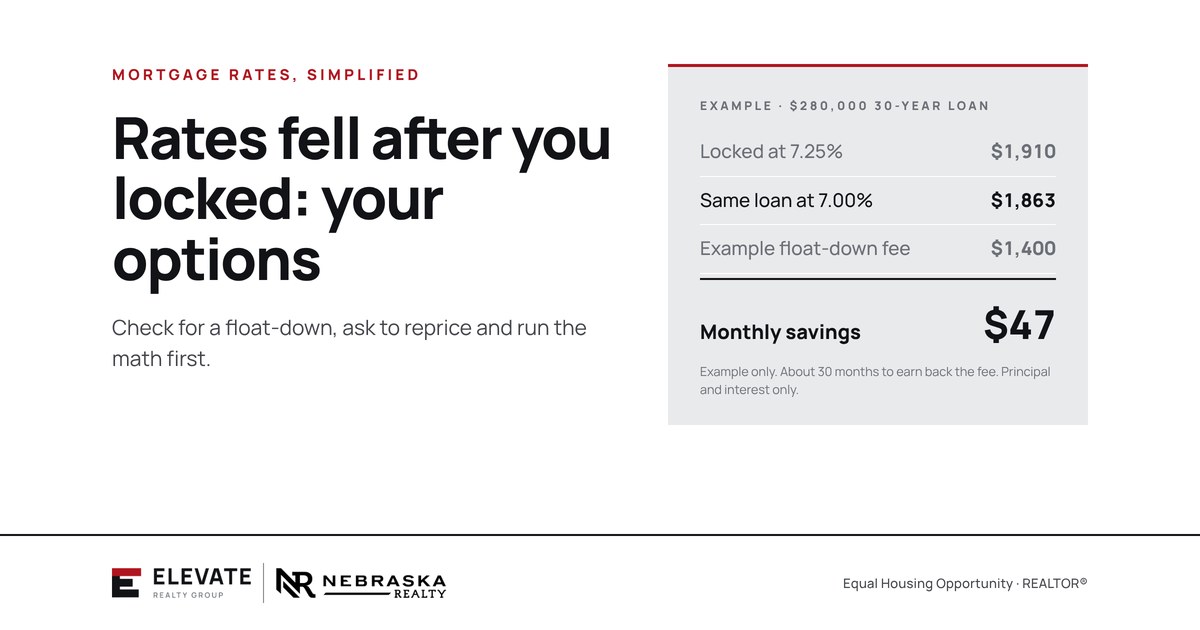
Most people feel the rate drop as a big deal. On a monthly payment it’s often smaller than it sounds. This is an example, not a quote for any real loan:
- A $280,000 30-year fixed loan at 7.25% has a principal and interest payment of about $1,910 a month.
- The same loan at 7.00% is about $1,863 a month.
- That’s about $47 a month saved.
- If a float-down cost $1,400, it would take about 30 months of savings to earn that back.
If you plan to stay in the home and keep the loan for years, that can be worth it. If there’s a decent chance you’ll sell or refinance in the next couple of years, it may not be. And principal and interest is only part of the payment. Our breakdown of the real monthly payment on a Lincoln home shows how taxes and insurance add to it, and why your mortgage payment can go up even on a fixed rate explains the escrow side.
How to handle a rate drop after you lock, step by step
- Find your lock terms. Check page 1 of your Loan Estimate for the lock and its end date, then pull up your written lock agreement.
- Look for a float-down. Note the minimum drop, the fee and the deadline if your agreement has one.
- Ask your loan officer. Ask whether they’ll float down, reprice or relock. Then ask what each one costs.
- Run the break-even. Divide the cost by the monthly savings to see how many months it takes to pay off.
- Protect your closing date. Don’t trade a small savings for a missed deadline or an expired lock.
If you’re also counting every dollar you’ll need at the table, our guide to how much cash you need to close on a Lincoln home pairs well with this decision. And if the payment already feels tight at either rate, read how much house you can afford without being house poor before you chase a quarter point.
I talk buyers through this exact question every time rates move during a contract. The answer depends on your lock terms, your closing date and how long you’ll keep the loan, so it’s worth running your real numbers before you call the lender.
Frequently asked questions
Can I get a lower rate if rates drop after I lock?
Only if your lender agrees. You may have a float-down option in your lock agreement or your lender may be willing to reprice or relock. You can also apply with a different lender. Without one of those, a rate lock holds you to the locked rate.
What is a mortgage float-down option?
A float-down is a feature some lenders add to a rate lock that lets your locked rate move down once if market rates fall before closing. It may require a minimum rate drop and often comes with a fee, and not every lender offers it.
How long does a mortgage rate lock last?
The CFPB says rate locks are typically available for 30, 45 or 60 days and sometimes longer. Your Loan Estimate shows at the top of page 1 whether your rate is locked and for how long.
Can my locked rate change before closing?
Yes, if your application changes. The CFPB says a locked rate can still change if there are changes to your loan amount, credit score or verified income. It can also become costly if your lock expires before you close.
Should I switch lenders to get a lower rate?
Only if the savings are worth the time and risk. A new lender has to give you a new Loan Estimate within three business days of your application and then underwrite your loan from the start, which can strain your closing date. Compare the monthly savings with any fees you’d lose.
The short version
A rate lock protects you from rising rates, not falling ones. If rates drop after you lock, check your lock agreement for a float-down, ask your lender to reprice and only switch lenders if the savings clearly beat the cost and your closing date is safe.
If you’re thinking through this for your own purchase, I’m happy to walk you through the numbers. Reach out to Elevate Realty Group anytime.
About Jorin Masley
Jorin Masley is a REALTOR® and Team Lead at Elevate Realty Group, brokered by Nebraska Realty. He leads with clarity: he makes the complicated plain and shows you the real numbers early. He serves Lincoln and the surrounding communities of Milford, Seward, Beatrice, Crete, Waverly, Hickman and Roca.