



What happens if the appraisal comes in low?
When the appraisal comes in below your purchase price, your lender bases the loan on the lower number, so the gap has to be covered or closed. You usually have four options: ask the lender for a reconsideration of value if the appraisal missed something, renegotiate the price with the seller, bring extra cash to cover the difference or cancel under your appraisal contingency. Most low appraisals end with some mix of the first three.

By Jorin Masley | November 22, 2026
A low appraisal feels like the deal just fell apart. It almost never has. It means the number on the purchase agreement and the number on the appraisal don’t match yet, and someone has to move.
Here’s what the gap actually costs you, who can close it and how to decide what to do before your deadline passes.
Prefer to watch? Here’s the 46-second version.
https://www.youtube.com/watch?v=ljs3wZ0VRWw
Why a low appraisal changes your loan
Your lender orders the appraisal to check the value of the home it’s lending against. Freddie Mac describes an appraisal as an opinion of the market value of a home from a third-party professional with state-issued appraiser credentials.
For a conventional purchase loan, Fannie Mae’s Selling Guide sets the property value as the lower of the sales price or the current appraised value. Your loan-to-value ratio, and with it your loan amount, is figured from that lower number. The lender won’t lend against value the appraiser didn’t find.
What the gap looks like with real numbers
This is an example, not a quote for any real home:
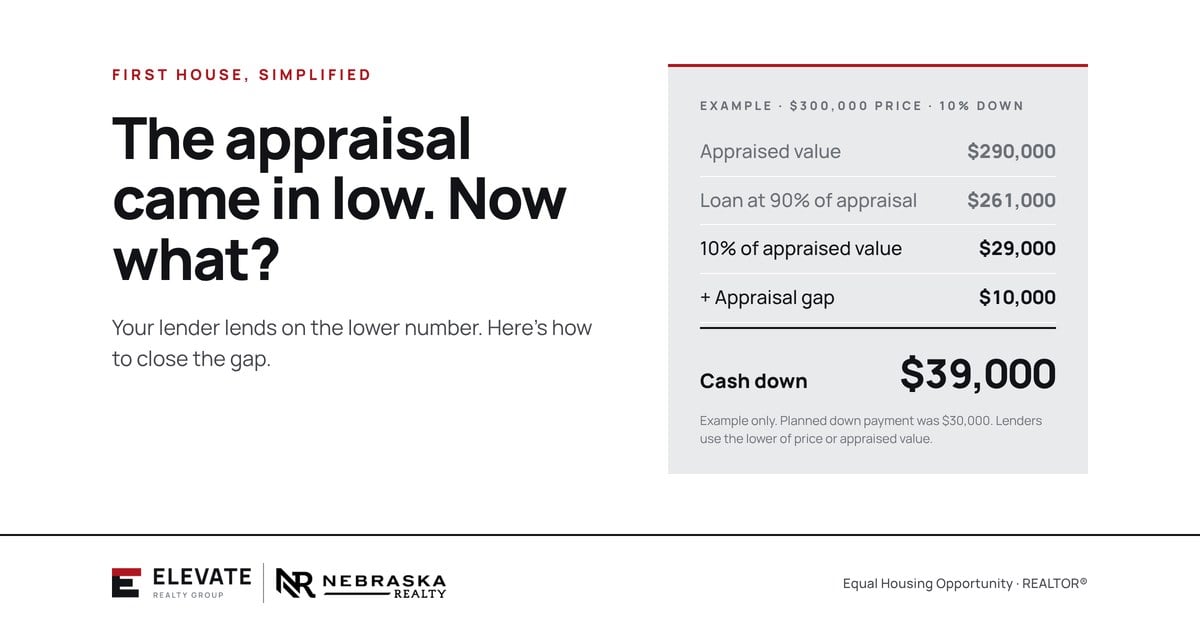
- You agreed to pay $300,000 and planned to put 10% down, or $30,000, with a $270,000 loan.
- The appraisal comes in at $290,000.
- Your lender now figures 90% of $290,000, which is a $261,000 loan.
- To still pay $300,000, you’d need $39,000 down instead of $30,000. That’s 10% of the appraised value ($29,000) plus the full $10,000 gap.
Same house, same price, $9,000 more cash at closing. That’s why a low appraisal matters even when you love the home.
Your four options when the appraisal comes in low
1. Check the appraisal and ask for a reconsideration of value
Start by reading the report. The Consumer Financial Protection Bureau (CFPB) says you have the right to a free copy of your appraisal for a first-lien mortgage, sent promptly after it’s completed and no later than three days before your loan closes. If you don’t have it yet, ask your lender for it now.
Look for:
- Wrong facts about the home: square footage, bedroom or bathroom count, finished basement, garage size
- Weak comparable sales: homes that are older, smaller, farther away or sold a long time ago when better matches sold recently
- Missed updates: a new roof, furnace or kitchen that didn’t make it into the adjustments
If you find real problems, you can ask for a reconsideration of value (ROV). On conventional loans, Fannie Mae requires lenders to have a process for a borrower-initiated reconsideration of value. Your request has to point to what’s unsupported or inaccurate and explain why the new data supports a different value. You can include up to five additional comparable properties with their data sources, like the multiple listing service (MLS) number.
Two things to know before you file:
- You get one. Fannie Mae allows one borrower-initiated ROV per appraisal report, so make it count.
- It isn’t a do-over. If the appraiser reviews it and the value doesn’t change, Fannie Mae says you can’t then request a new appraisal. Whether to accept the appraiser’s conclusion is the lender’s call.
This is where your agent earns their keep. We pull the recent sales the appraiser may have missed and help you write a request that gives the appraiser something concrete to review.
2. Renegotiate the price
The appraisal is leverage. The CFPB calls it strong evidence that the price was above the market value of the home and says asking the seller to reduce the price is a good next step.
The seller has a reason to listen. If your deal falls apart, the next buyer’s lender will order its own appraisal, and it may land in a similar place. Common outcomes:
- The seller drops the price to the appraised value.
- You split the difference. In the example, the seller comes down $5,000 and you bring $5,000 more.
- The seller won’t move, and you decide whether to cover the gap or walk.
3. Bring more cash to cover the gap
If the seller won’t budge and you still want the home, Freddie Mac notes you can put more money toward your down payment to make up the difference between the loan amount and the price.
Before you do, ask yourself two questions:
- Can you cover it and still keep a cushion? Draining your savings to win a house leaves you nothing for the first furnace repair. Our breakdown of how much cash you need to close shows where the rest of your money is already going.
- Are you comfortable paying more than the appraised value? The CFPB is blunt that buying above appraised value is very risky. If you need to sell in a year or two, you start out behind. Our post on how to know you didn’t overpay walks through how to judge that.
Some buyers agree to this ahead of time with an appraisal gap clause in the offer, promising to cover a set amount if the appraisal comes in short. That makes an offer stronger in a competitive spot, but it’s real money you’ve committed before you’ve seen the appraisal. Only offer what you could actually write a check for.
4. Cancel under your appraisal contingency
If your purchase agreement includes an appraisal contingency, you may be able to cancel if the home appraises below the price. Freddie Mac notes this clause is what allows you to cancel the contract.
What decides whether you get your earnest money back is the wording of your contract and whether you act before its deadline. Read the contingency with your agent the day the appraisal arrives, not the day before the deadline. The CFPB suggests considering an attorney if you’re unsure of your options. If you’re weighing whether to walk for other reasons too, our guide on when to walk away from a house covers the same deadline thinking.
How to handle a low appraisal step by step
- Get the full report. Ask your lender for the appraisal and note your contingency deadline on the calendar.
- Find the gap. Figure out how much more cash the lower value means for you at closing, not just the difference in price.
- Check the facts and comparable sales. If something is wrong or missing, work with your agent and lender on one well-supported reconsideration of value.
- Negotiate with the seller. Share the appraisal and ask for a lower price or a split.
- Decide before the deadline. Close at the new terms, cover the gap with cash you can spare or cancel under the contingency.
The math on a low appraisal is usually simple. The hard part is deciding fast, with clear numbers, before a deadline makes the decision for you. That’s the part I’d sit down and run with you.
Frequently asked questions
Can a low appraisal kill a home sale?
It can, but it usually doesn’t. Most low appraisals are resolved by a price reduction, the buyer bringing more cash or a mix of both. The deal ends only if neither side moves and the buyer cancels under the appraisal contingency.
Can I dispute a low appraisal?
Yes. Ask your lender for a reconsideration of value and include what the appraiser got wrong plus up to five better comparable sales. On conventional loans, Fannie Mae allows one borrower-initiated reconsideration per appraisal report.
Does the seller have to lower the price if the appraisal is low?
No. The seller can lower the price, meet you partway or refuse. A low appraisal gives you strong evidence to negotiate with, and if you have an appraisal contingency, the option to cancel.
Do I get my earnest money back if the appraisal is low?
It depends on your purchase agreement. With an appraisal contingency and notice given before its deadline, buyers can often cancel and keep their earnest money. Without one, or after the deadline, you could lose it.
How is my loan amount figured after a low appraisal?
On a conventional purchase loan, the lender uses the lower of the sales price or the appraised value. Your down payment percentage applies to that lower number, so any amount above it comes out of your pocket.
The short version
A low appraisal means your lender will only lend against the lower value. Read the report, challenge real errors with one solid reconsideration of value, negotiate with the seller and decide before your contingency deadline whether to cover the gap or walk.
If you’re thinking through this for your own purchase, I’m happy to walk you through the numbers. Reach out to Elevate Realty Group anytime.
About Jorin Masley
Jorin Masley is a REALTOR® and Team Lead at Elevate Realty Group, brokered by Nebraska Realty. He leads with clarity: he makes the complicated plain and shows you the real numbers early. He serves Lincoln and the surrounding communities of Milford, Seward, Beatrice, Crete, Waverly, Hickman and Roca.