



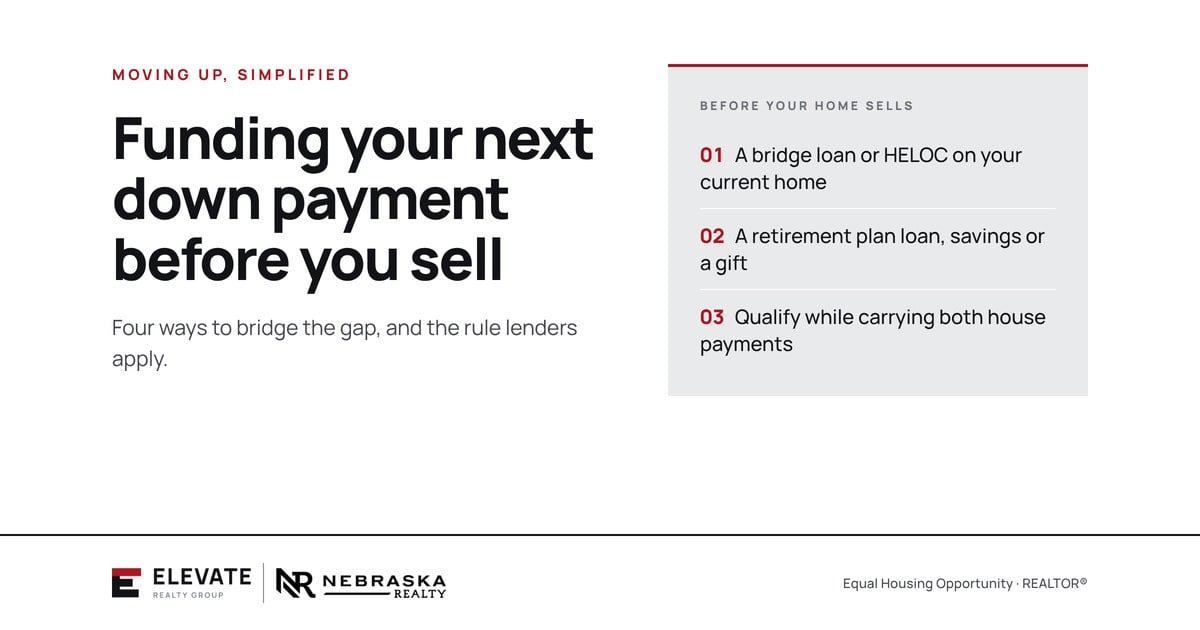
How do you pay the down payment on your next home before your current one sells?
Most move-up buyers use one of four sources: a bridge loan secured by the home they’re selling, a home equity line of credit (HELOC) opened before they list, a loan from a workplace retirement plan like a 401(k) and their own savings or gift money. Each one lets you buy first. The catch is qualifying: under Fannie Mae’s rules, your lender counts both house payments unless your current home is under contract and the buyer’s financing contingency has cleared. If two payments don’t fit, a home sale contingency or selling first is usually the safer path.

By Jorin Masley | November 21, 2026
Most of the equity you need for your next down payment is sitting in the house you live in now. The problem is timing. The home you want is for sale today, and your money is locked up until your own sale closes.
That’s the question behind almost every buy-first plan I walk through with sellers in Lincoln: where does the down payment come from in the gap? If you’re still deciding which order to go in, start with our buy first or sell first guide. This post is for when you’ve decided to buy first and need to fund it.
Prefer to watch? Here’s the 44-second version.
https://www.youtube.com/watch?v=RHewZV_pVXk
Four ways to fund the down payment before you sell
1. A bridge loan
A bridge loan (sometimes called a swing loan) is a short-term loan secured by your current home. You use it for the down payment and closing costs on the new one, then pay it off when your house sells.
Fannie Mae’s Selling Guide treats a bridge loan as an acceptable source of funds for a conventional loan, with a few conditions:
- It can’t be tied to the new house. The bridge loan can’t be cross-collateralized against the property you’re buying.
- You have to show you can carry everything. The lender must document that you can make the payments on the new home, the current home, the bridge loan and your other debts.
- Fannie Mae doesn’t set a term limit. The bridge lender sets the length, rate and fees, so compare them.
Best for: Sellers with solid equity whose home should sell fairly quickly and who can handle the payments for a few months if it doesn’t.
2. A home equity line of credit (HELOC)
A HELOC is a line of credit that lets you borrow, spend and repay as you go, using your home as collateral, according to the Consumer Financial Protection Bureau (CFPB). You draw what you need for the down payment and pay it off from your sale proceeds.
What the CFPB’s HELOC booklet says to watch for:
- The rate usually moves. HELOCs typically have variable rates, so your payment can change even if you don’t borrow more.
- The line can shrink. HELOCs generally let the lender freeze or reduce your line if your home’s value falls.
- It comes due when you sell. If you sell your home, you’re generally required to pay off the HELOC in full right away. For a buy-first plan, that’s the point.
- There can be fees. Some lenders waive up-front costs. Others charge closing costs like title search and filing fees.
Timing matters here. Opening a line takes time, and the lender decides whether to open one on a home you’re about to put on the market. If a HELOC is your plan, apply before you list and tell the lender exactly what you’re doing.
Best for: Owners who plan ahead, have equity and want to borrow only what they actually use.
3. A loan from your 401(k) or other workplace plan
If your employer’s plan allows loans, you can borrow from your own balance. The Internal Revenue Service (IRS) caps a plan loan at $50,000 or, if less, the greater of $10,000 or 50% of your vested balance.
- Repayment: Plan loans generally must be repaid within 5 years in substantially equal payments. A loan used to buy your principal residence may be allowed a longer payback.
- If it isn’t repaid: A loan that isn’t paid back on its terms is treated as a distribution, which means it’s taxed, including any early distribution tax.
- If you change jobs: The CFPB’s booklet notes that if you leave or lose your job, you may have to repay the whole amount then or pay taxes and penalties.
Best for: Buyers who need a smaller amount, have steady employment and plan to repay the loan from the sale. Talk to your plan administrator and a tax professional before you count on it.
4. Savings, gift money or a smaller down payment
Sometimes the simplest answer is to put less down on the new home and use your sale proceeds afterward. A smaller down payment can mean private mortgage insurance and a larger loan, but it can also mean you don’t need a bridge at all.
A gift toward the down payment is another option. Lenders have documentation rules for gifts, so tell your lender early if you’re planning on one.
Best for: Buyers with cash reserves or a planned gift who would rather avoid a second loan.
The part that trips people up: qualifying for two payments
Funding the down payment is only half of it. Your lender also has to approve you for the new loan while you still own the old house.
Under Fannie Mae’s rules for a current home that’s pending sale, if your sale won’t close before your purchase does, the lender qualifies you using both payments: your current home’s principal, interest, taxes, insurance and association dues (PITIA) and the new home’s PITIA.
There’s one way around it. Fannie Mae won’t require your current payment to be counted if the lender has:
- the signed purchase agreement on your current home, and
- confirmation that the buyer’s financing contingencies have cleared.
So timing your sale matters as much as the money. If your buyer’s loan is nearly done before your purchase closes, the math gets much easier.
An example with round numbers
This is an example, not a quote for any real situation:
- Your household income is $9,000 a month.
- Your current house payment is $1,600, the new one would be $2,400 and you have a $400 car payment.
- With both house payments counted, your monthly debts are $4,400, about 49% of your income.
- Once your buyer’s financing contingency clears and the old payment drops out, debts fall to $2,800, about 31%.
If a bridge loan or HELOC adds its own payment, that goes on the list too. Every lender has its own ceiling for that percentage, so ask yours for the number. Our post on how much house you can afford without being house poor walks through how that ratio works.
If you plan to keep your current home as a rental instead of selling it, the lender uses a different set of rules. Bring that up on the first call.
Which option fits your move
- Lots of equity, home ready to list soon: A bridge loan or a HELOC opened before you list.
- Need a smaller amount: A retirement plan loan, savings or a smaller down payment.
- Can’t qualify for both payments: A home sale contingency, or sell first and plan your move around the closing date.
- Not sure how much cash you’ll need: Start with our breakdown of how much cash you need to close, then work backward.
How to set up a buy-first plan
- Talk to your lender before you list. Ask whether they’ll count both payments, what your ceiling is and which funding source they’ll accept.
- Get a realistic value for your current home. Your equity, after your payoff and selling costs, is what you’re really borrowing against.
- Line up the funding source. Apply for the bridge loan or HELOC, or confirm your plan allows a loan, before you write an offer.
- Write the offer around your timeline. Your agent can set closing dates that give your own sale the best chance of landing first.
- Plan the payoff. Know exactly how the bridge loan, HELOC or plan loan gets repaid from your sale proceeds at closing.
Every buy-first plan comes down to two numbers: how much equity you can reach and how many months of double payments you can carry. That’s the math I’d run with you before you fall for a house.
Frequently asked questions
What is a bridge loan when buying a house?
A bridge loan is a short-term loan secured by the home you’re selling. You use it for the down payment and closing costs on your next home, then pay it off when your current home sells.
Can I use a HELOC for a down payment on another house?
Often, yes, if you open it before you list and your lender accepts it as a source of funds. The CFPB notes HELOCs usually have variable rates, the lender can freeze or reduce the line if your home’s value falls and you generally have to pay it off in full when you sell.
Will my lender count both mortgage payments?
Under Fannie Mae’s rules, yes, if your current home won’t sell before your new loan closes. The current payment can be left out once your home is under contract and the buyer’s financing contingencies have cleared.
How much can I borrow from my 401(k) to buy a house?
The IRS limit is $50,000 or, if less, the greater of $10,000 or 50% of your vested balance. Your plan has to allow loans, and a loan that isn’t repaid on its terms is taxed as a distribution.
What if my house doesn’t sell as fast as I planned?
You’ll carry both payments, plus any bridge loan or HELOC payment, until it does. Before you buy first, figure out how many months you could handle that, and talk with your agent about pricing your home to sell within that window.
The short version
You can fund your next down payment with a bridge loan, a HELOC, a retirement plan loan or cash, but the bigger question is whether you can qualify for and carry two payments until your home sells. Talk to your lender before you list, and line up the money before you write the offer.
If you’re thinking through this for your own move, I’m happy to walk you through the numbers. Reach out to Elevate Realty Group anytime.
About Jorin Masley
Jorin Masley is a REALTOR® and Team Lead at Elevate Realty Group, brokered by Nebraska Realty. He leads with clarity: he makes the complicated plain and shows you the real numbers early. He serves Lincoln and the surrounding communities of Milford, Seward, Beatrice, Crete, Waverly, Hickman and Roca.