



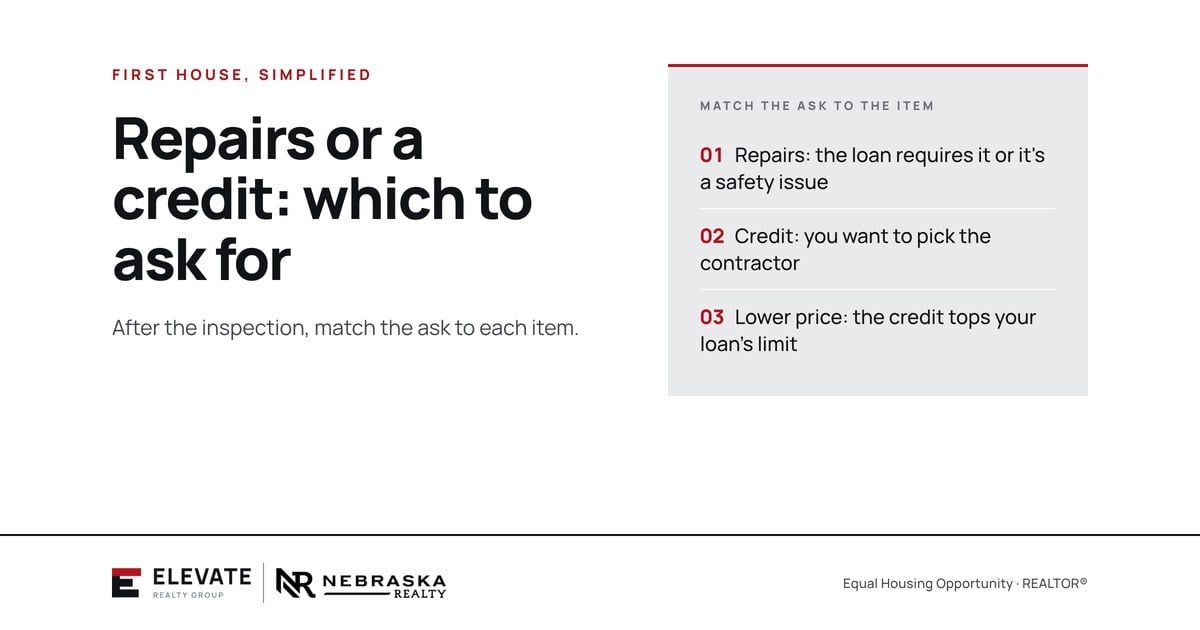
Should you ask the seller to make repairs or give you a credit?
For most inspection items, a closing credit gives you more control: you choose the contractor, the timing and the quality of the work. Ask for repairs when your lender requires the fix before closing or when it’s a safety problem you don’t want to live with on day one. Keep in mind that a credit goes toward your closing costs, not into your pocket, and your loan type caps how big it can be. Fannie Mae, for example, limits seller contributions to 3% of the price when you put less than 10% down.

By Cassi Ohlin | November 20, 2026
The inspection is done. You’ve read the report, maybe twice. Now your agent asks the question that decides the next week of your life: do you want the seller to fix things, or do you want money instead?
There’s no single right answer. But there is a right answer for each item on your list, and it usually comes down to three things: who you trust to do the work, whether the loan needs it done first and how much cash you’ll have after closing.
If you’re still sorting the report itself, start with our post on what happens when the inspection finds problems. This one picks up at the point where you know what you want fixed and need to decide how to ask for it.
Prefer to watch? Here’s the 44-second version.
https://www.youtube.com/watch?v=7hyQEM5tWQU
Your three options: repairs, a credit or a lower price
Once you’ve decided an item is worth raising, you can ask for it three ways.
1. The seller makes the repair before closing. The seller hires someone, pays for it and the work is done before you get the keys.
- The upside: It’s finished before you move in, and you don’t need cash after closing to pay for it.
- The downside: The seller picks the contractor. The seller’s goal is to check the box, not to do the job the way you would. Repairs can also push your timeline if a contractor is booked out.
2. The seller gives you a credit at closing. Instead of doing the work, the seller agrees to pay part of your closing costs. You make the repair yourself after you own the home.
- The upside: You choose who does the work, when and how well. You can also put the money toward a bigger fix you were planning anyway.
- The downside: The credit lowers what you bring to closing. It doesn’t hand you a repair fund. You’ll pay the contractor out of your own savings later, so plan for that.
3. The seller lowers the price. The purchase price drops by an agreed amount.
- The upside: It isn’t held to the seller-credit limits below, and there’s no repair to manage before closing.
- The downside: A lower price mostly shows up as a slightly smaller loan and payment. It doesn’t help much with cash when the repair bill arrives.
How a seller credit works, and its limits
This is the part most buyers don’t hear about until it causes a problem.
The Consumer Financial Protection Bureau (CFPB) describes the seller credit as the amount the seller has agreed to contribute to your closing costs. It shows up on your Closing Disclosure, the final form your lender has to give you at least three business days before closing. The CFPB’s advice is simple: check that the seller credit matches what you agreed to.
Your loan sets the ceiling
Lenders limit how much a seller can contribute. On a conventional loan sold to Fannie Mae, the interested party contribution limits for a home you’ll live in are based on your loan-to-value (LTV) ratio:
- Less than 10% down (LTV over 90%): up to 3%
- 10% to just under 25% down (LTV from 75.01% to 90%): up to 6%
- 25% or more down (LTV of 75% or less): up to 9%
Fannie Mae measures the percentage against the lower of the sales price or the appraised value. A few more rules on that same page matter here:
- A credit can’t pay your down payment. Fannie Mae doesn’t allow seller contributions to be used for the down payment or reserves.
- It has to fit inside your actual closing costs. Credits can cover closing costs, including prepaids. Anything more than your closing costs is treated as a sales concession and comes off the sales price.
- Over the limit works the same way. A contribution above the percentage cap is also deducted from the price.
Federal Housing Administration (FHA), Department of Veterans Affairs (VA) and U.S. Department of Agriculture (USDA) loans have their own limits. Ask your lender for the number on your loan before you write the request.
An example with round numbers
This is an example, not a quote for any real home:
- You’re buying a $300,000 home with 5% down on a conventional loan.
- The 3% cap is $9,000.
- Your closing costs and prepaids come to $7,500, and the seller already agreed to cover $3,000 of them in your offer.
- That leaves room for about $4,500 more in credits. If the inspection items add up to $6,000, a credit alone won’t cover all of it.
In that case you might ask for a $4,500 credit and a small price reduction, or a credit plus one repair the seller handles. Your lender can tell you how much room is left before you send anything. Our post on how much cash you need to close shows where those closing cost and prepaid numbers come from.
When to ask for repairs and when to ask for a credit
Here’s how I help buyers sort each item.
Ask the seller to make the repair when:
- Your lender requires it before closing. Some loans and appraisals call for certain items to be fixed before the loan can close. If that’s the case, a credit won’t solve it. Ask your lender early.
- It’s a safety issue you don’t want to live with for a single night. A gas leak, exposed wiring or a furnace that won’t run in December are easier to have handled before you move in.
- The fix is simple and easy to check. A missing handrail or a loose outlet cover is quick to verify at the final walk-through.
Ask for a credit when:
- You want to choose the contractor. Roofs, furnaces, sewer lines and foundation work are big jobs. You’ll live with the result for years, so you should pick who does it.
- You’d replace it anyway. If the water heater is near the end of its life and you’d rather upgrade, a credit lets you buy the one you want.
- Time is short. Contractors in Lincoln can be booked out in busy seasons. A credit doesn’t depend on anyone’s schedule.
- The seller can’t easily manage the work. An out-of-town seller or an estate sale can make repairs hard to coordinate and hard to confirm.
Ask for a price reduction when:
- The credit you want is more than your loan allows, or bigger than your closing costs.
- You plan to do the work much later and would rather lower the loan amount now.
How to ask so the seller says yes
How you ask matters as much as what you ask for.
- Get quotes during the inspection period. A real contractor quote carries more weight than a guess. Your purchase agreement sets the deadline to respond, so start calling right away.
- Attach the inspection pages. Point to the exact items and photos. It keeps the conversation about the house, not opinions.
- Ask for what matters. Safety items and big systems first. A list of 40 small things makes it harder for a seller to say yes to the ones that count.
- Put repair terms in writing. If the seller is making repairs, ask for licensed contractors where the work calls for it, paid receipts and time to check the work at the final walk-through.
- Confirm the credit with your lender. Before you sign the amendment, make sure the credit fits your loan’s limit and your closing costs.
If the seller won’t budge on something that matters, that’s a different decision. Our post on when to walk away after the inspection covers that.
Frequently asked questions
Is it better to ask for repairs or a credit after a home inspection?
For most items, a credit gives you more control because you choose the contractor and the quality of the work. Ask for repairs when your lender requires the fix before closing or when it’s a safety issue you need handled before you move in.
Can a seller credit be used for repairs?
Not directly. A seller credit pays part of your closing costs, which lowers the cash you bring to closing. You then pay for the repair yourself after you own the home, so plan to have that money set aside.
How much can a seller credit be?
It depends on your loan. For a conventional loan sold to Fannie Mae on a home you’ll live in, the limit is 3% with less than 10% down, 6% with 10% to just under 25% down and 9% with 25% or more down. The credit also can’t be more than your actual closing costs.
What happens if the seller credit is more than my closing costs?
Under Fannie Mae’s rules, anything above your closing costs is treated as a sales concession and comes off the sales price. Your lender may ask to restructure the deal, so check the number with them before you sign.
Should I ask for a price reduction instead of a credit?
A price reduction makes sense when the amount you need is more than your loan allows as a credit, or when you’d rather lower the loan amount. Keep in mind it does less for your cash at closing than a credit does.
The short version
A credit usually gives you more control over how the work gets done, and repairs make sense when the loan requires them or safety can’t wait. Either way, check your loan’s limit on seller credits, get real quotes and put every term in writing.
If you’re thinking through this for your own situation, I’m happy to walk you through it. Reach out to Elevate Realty Group anytime.
About Cassi Ohlin
Cassi Ohlin is a REALTOR® and Team Lead at Elevate Realty Group, brokered by Nebraska Realty. She leads with warmth: she makes you feel like the only person in the room. She’s based in Milford and serves Lincoln and the surrounding communities of Milford, Seward, Beatrice, Crete, Waverly, Hickman and Roca.