



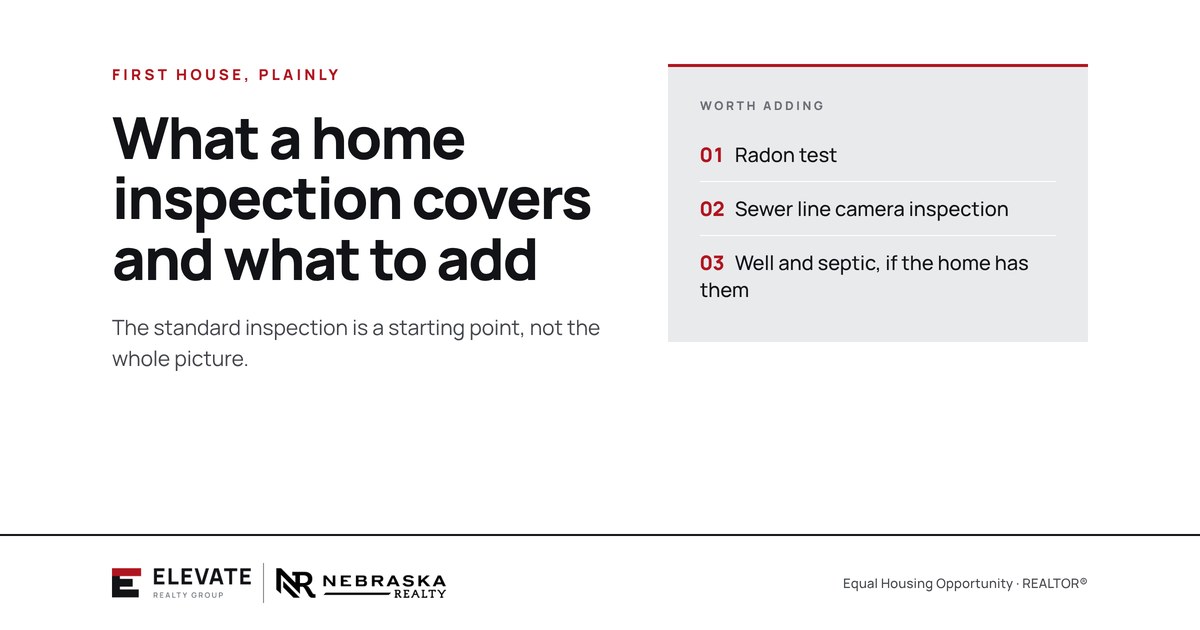
What does a home inspection in Lincoln cover, and what should you add?
A standard home inspection is a visual check of the house’s major systems: roof, exterior, foundation and structure, heating, cooling, plumbing, electrical, attic and interior. It does not test for radon, look inside the sewer line, check for pests or inspect a private well or septic system. In Lancaster County, homes served by a private well or septic system also need a separate point-of-sale inspection before they can be sold, and the seller arranges it.
By Cassi Ohlin | November 13, 2026
You’ve got an accepted offer and an inspection deadline in your contract. Now someone asks which inspections you want, and you’re not sure what “the inspection” even includes.
Here’s the short version. The general home inspection is the foundation. It’s thorough, but it has a defined scope, and some of the most expensive surprises sit just outside it. Knowing where that line is lets you decide what to add before your deadline runs out, not after.
What the standard inspection covers
Most home inspectors work from a published standard of practice. The InterNACHI (International Association of Certified Home Inspectors) standards of practice are a good picture of what a general inspection includes. Under those standards, your inspector looks at:
- Roof: roof covering, gutters, downspouts, vents, flashing, skylights and chimney
- Exterior: siding, eaves, soffits, exterior doors, decks, porches, walkways and the grading and drainage around the house
- Foundation and structure: basement, crawl space and structural components
- Heating and cooling: both systems, run with their normal controls
- Plumbing: main water and fuel shut-offs, water heater, fixtures, toilets, drains and sump pump
- Electrical: service entrance, main disconnect, panels, breakers, grounding, a sample of outlets and switches, GFCI (ground fault circuit interrupter) outlets and whether smoke and carbon monoxide detectors are present
- Fireplace: the visible parts of the fireplace and chimney
- Attic: insulation, ventilation and exhaust fans in the kitchen, bathrooms and laundry
- Interior: a sample of doors and windows, floors, walls, ceilings, stairs, railings and the garage door and opener
That’s a lot of house. For most buyers, the general inspection is where the real decisions come from: the aging furnace, the roof with a few years left, the outlet that isn’t grounded.
Ask your inspector which standard they follow. It tells you exactly what they’re promising to look at.
What it doesn’t cover
The same standards are clear about the limits. A general inspection is “not technically exhaustive” and won’t find defects that are concealed or hidden. Under the InterNACHI standards, the inspector is not required to:
- Test for radon or other airborne hazards
- Determine whether mold is present
- Look for evidence of pests, including insects and rodents
- Inspect wells, septic systems or drainfields
- Test the water quality or reliability of the water supply
- Inspect underground items or underground utilities
- Inspect swimming pools or spas
- Check code compliance or tell you how long a system will last
- Inspect anything that isn’t readily accessible
None of this means your inspector is cutting corners. It means each of those items needs a different tool, test or license. That’s what the add-ons are for.
The add-ons worth considering
You don’t need every test on every house. Here’s how I’d think about each one with my clients.
Radon test
This is the one I’d put on nearly every Nebraska purchase. Radon is an odorless gas that comes up from the soil, and you can’t see it or smell it. The Nebraska Department of Health and Human Services radon fact sheet puts it plainly: “All Nebraska homes should be tested for radon because any home can have a radon problem.”
The EPA (Environmental Protection Agency) recommended action level is 4 pCi/L (picocuries per liter). If a test comes back at or above that, mitigation is usually a fixable problem, and the result gives you something concrete to talk about with the seller during your inspection window.
Sewer scope
A sewer scope runs a camera down the line from the house toward the street. It’s worth a hard look on older homes or properties with mature trees in the yard, because roots, cracked pipe and sagging sections stay invisible until something backs up. Since the general inspection doesn’t cover underground lines, this is the only way to know what’s down there before you own it.
Wood-destroying insect inspection
Termites and other wood-destroying insects are outside the general inspection’s scope. Some loan programs ask for this inspection, so check with your lender first. Even when it’s optional, it’s worth considering on homes with wood in contact with the soil or past signs of moisture.
Mold
If the inspector notes water staining, a musty basement or past leaks, a mold assessment can tell you what you’re dealing with. On a dry, well-ventilated house with no signs of moisture, many buyers skip it.
Roof specialist
If the general inspector flags hail damage or a roof near the end of its life, a roofer can tell you what it would cost to repair or replace. That matters more than you might expect here. A roof’s age and condition affect your insurance coverage too, which I cover in why Nebraska homeowners insurance costs so much.
Heating, cooling and other specialists
When the inspector writes “recommend evaluation by a licensed contractor,” take it seriously. A heating and cooling technician, electrician or structural engineer can turn a vague flag into a real number before your deadline passes.
Homes with a well or septic system in Lancaster County
This one is different, because it’s not optional and it’s not yours to order.
The Lincoln-Lancaster County Health Department Water Quality page says that “all properties with residences served by a private water well or onsite wastewater system must be inspected prior to the sale, transfer or conveyance of the property.”
A few things to know:
- The seller arranges it. The page says “the property owner selects and contracts with the licensed Property Transfer Inspector.”
- Only permitted inspectors can do it. The inspection is done by private companies that hold a Property Transfer Inspector permit issued by the health department.
- You can call with questions. The health department’s property transfer line is 402-441-8031.
This required inspection is separate from your own general inspection. Your general inspector isn’t required to look at the well or septic system at all, so ask early whether the transfer inspection has been done and request a copy of the results. If you’re buying an acreage, you may also want your own water quality test.
This rule applies in Lancaster County. If you’re buying in a neighboring county such as Saline or Seward, ask your agent and lender what’s expected there instead of assuming the same process.
How to plan your inspections
The order matters, because your contract gives you a limited window.
- Book the general inspection right away. Inspectors’ calendars fill up, and every other decision builds on this report.
- Add radon at the same time. A radon test has to sit in the house for a set period before it can be read, so starting early keeps you inside your deadline.
- Decide on the sewer scope, insect and mold checks up front. Base it on the home’s age, setting and what you see on your showings.
- Order specialists as soon as the report flags something. Waiting until the last day leaves you without quotes when you need them.
- On a well or septic home, ask for the transfer inspection results. Get them in hand before your deadline.
- Sort what you’ve found and decide your next step. I walk through that in the inspection found problems: here’s what happens next, and if the findings are serious, when to walk away from a house after the inspection can help you think it through.
Every house is different, and so is every buyer’s comfort with risk. A 1950s home in an established Lincoln neighborhood calls for a different plan than a brand-new build in Waverly or an acreage outside Hickman. That’s a conversation worth having before you schedule anything.
Frequently asked questions
Does a home inspection include a radon test in Nebraska?
Not usually. Under common standards of practice like InterNACHI’s, a general inspector is not required to test for radon. Many inspectors offer it as an add-on, so ask for it when you book.
Is a well and septic inspection required when buying a home in Lancaster County?
Yes. The Lincoln-Lancaster County Health Department requires homes served by a private well or septic system to be inspected before sale or transfer. The property owner selects and contracts with a permitted Property Transfer Inspector.
Does a home inspection check the sewer line?
A general inspection checks the drains inside the house but does not look inside underground lines. A sewer scope uses a camera to check the line from the house toward the street.
Can a home inspection find mold?
A general inspector can note signs of moisture, staining or past leaks, but standards like InterNACHI’s don’t require them to determine whether mold is present. If the report flags moisture, a mold assessment can give you a clearer answer.
Does a home inspection tell you how long the roof or furnace will last?
No. Inspectors aren’t required to estimate the remaining life of a system. If something looks near the end of its life, a roofer or heating and cooling technician can give you a better picture and a cost.
Before your deadline, not after
The general inspection covers the big systems you can see. The add-ons cover what it can’t, and in Lancaster County a well or septic home brings its own required inspection on top of that. Pick the add-ons that fit the house, schedule early and leave yourself time to act on what you learn.
If you’re thinking through this for your own situation, I’m happy to walk you through which inspections make sense for the home you’re buying. Reach out anytime at 402-728-8750 or [email protected].
About Cassi Ohlin
Cassi Ohlin is a REALTOR® and Team Lead at Elevate Realty Group, brokered by Nebraska Realty. She leads with warmth: she makes you feel like the only person in the room. Cassi is based in Milford and serves Lincoln and the surrounding communities of Milford, Seward, Beatrice, Crete, Waverly, Hickman and Roca.