



Should you open Nebraska’s first-time homebuyer savings account if you’re buying in 2027?
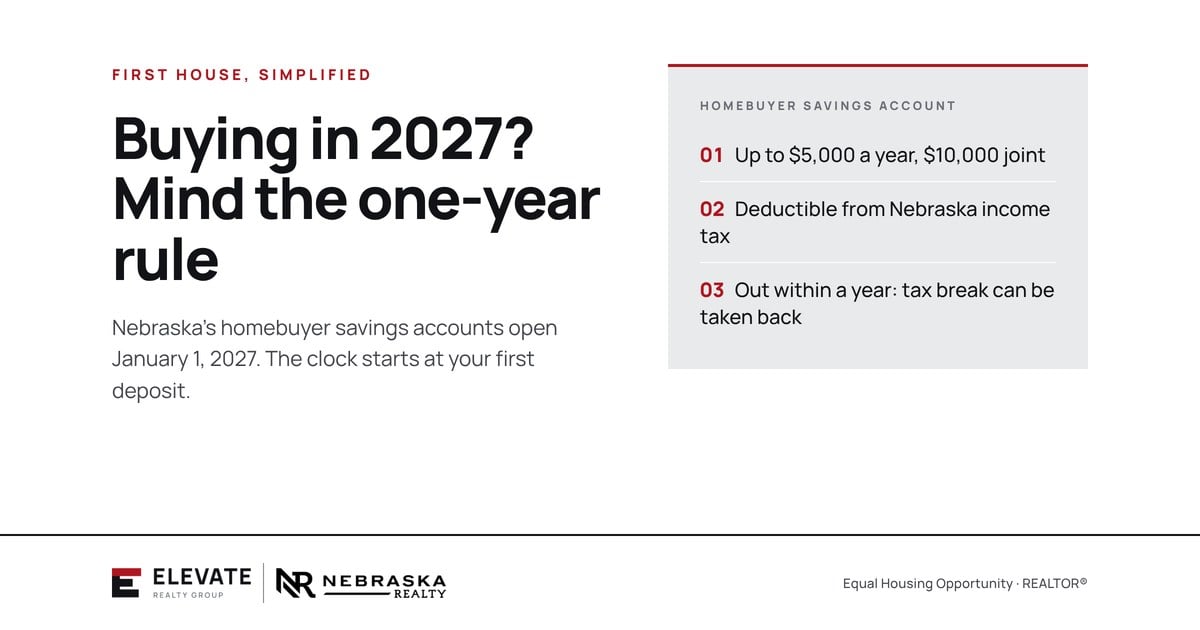
For the tax break alone, usually not. The accounts open January 1, 2027, and the Nebraska State Treasurer says the tax benefits can be taken back if money comes out less than a year after your first deposit. Since nobody can make a first deposit before January 1, 2027, a home you close on during 2027 lands inside that first year. The account pays off for buyers whose closing is at least a year after their first deposit, which means 2028 or later.

By Jorin Masley | November 25, 2026
Nebraska’s new First-Time Homebuyer Savings Account is getting a lot of attention, and the question I’m already hearing is a timing one: “We want to buy next year. Should we open one in January?”
It’s a fair question with a specific answer. The account is a good deal for some buyers and close to pointless for others, and the difference comes down to one date: your first deposit.
Prefer to watch? Here’s the 45-second version.
How Nebraska’s first-time homebuyer savings account works
Here’s what the Nebraska State Treasurer’s program page says, in plain terms:
- When and where: starting January 1, 2027, you can open one with a bank, credit union or other qualified financial institution.
- How much you can put in: up to $5,000 a year with a $25,000 lifetime limit for an individual. Married couples filing a joint return can put in up to $10,000 a year with a $50,000 lifetime limit.
- The tax break: contributions are fully deductible from Nebraska income taxes, and interest and earnings grow state tax-free when used for qualified expenses. It’s a Nebraska income tax benefit.
- What it pays for: down payments, closing costs, inspection fees, appraisal fees and mortgage origination fees on a primary residence in Nebraska, or the down payment and financing costs to build one.
- Who counts as a first-time homebuyer: someone who has never owned a primary residence, or someone who, after a divorce, hasn’t been on a property title for at least three consecutive years.
- Naming the buyer: you name a qualified beneficiary (you can name yourself) no later than April 15 of the year after the year you open the account.
- No deadline to buy: money can stay in the account indefinitely without penalty or recapture as long as you meet the rules.
The yearly and lifetime limits are written into state law at Nebraska Revised Statute 77-27,231, which also says you’re the one responsible for keeping records of your eligible expenses.
The one-year rule is the catch for 2027 buyers
The Treasurer’s page puts it directly: tax benefits can be recaptured if funds are withdrawn less than a year after the first deposit or are used for non-eligible purposes. “Recaptured” means the state can take back the tax break you claimed.
That’s where the calendar matters. Here are two examples (dates are examples only):
- You open and fund the account on January 4, 2027, and close on a home in September 2027. You’d be pulling the money out about eight months after your first deposit. That’s inside the one-year window, so the tax benefit can be taken back.
- You open and fund the account on January 4, 2027, and close in February 2028. You’re past the one-year mark, so the money can come out for your down payment and closing costs and you keep the tax benefit.
Every closing date in 2027 is less than a year after a first deposit made in 2027. So if you’re sure you’ll close next year, plan on this account giving you little or no tax advantage for that purchase.
The law does say an account can “pay or reimburse” eligible expenses. Whether you could buy in 2027 with other money and reimburse yourself from the account after the one-year mark isn’t spelled out on the Treasurer’s page. I’m a REALTOR®, not a tax advisor, so ask a tax professional before you count on that.
How much is the tax break, really?
Smaller than people expect, but real. The Treasurer’s own estimate for a single filer earning $70,000 who saves $25,000 over five years is about $1,100 in total state tax benefit. For a married couple earning $100,000 who saves $50,000 over five years, it’s about $2,200.
Those are the Treasurer’s estimates, built on Nebraska’s top income tax rate, which the Treasurer says will be 3.99%. As a rough example only, one year’s $5,000 contribution taxed at 3.99% works out to about $200. Your number depends on your income and your return.
When opening an account in January still makes sense
Even if you’re aiming for 2027, the account can still be worth opening in some situations:
- Your timeline is loose. If “next year” could easily become early 2028, opening and funding in January starts your one-year clock as early as possible.
- You’re really a 2028 or 2029 buyer. This is where the account shines. Fund it every year up to the limit and the deduction stacks up while you save.
- You file jointly. The $10,000 yearly limit lets couples who file a joint return build a down payment faster with a bigger deduction each year.
And if you’re set on closing in 2027, the savings plan matters more than the account type. Keep your down payment somewhere safe and easy to reach, and look at the programs built for buyers closing soon. Our guide to who qualifies for Nebraska Investment Finance Authority (NIFA) programs covers the state’s main first-time buyer loans. Then use our breakdown of how much cash you need to close on a Lincoln home to set the savings target.
How to decide in five minutes
- Pick your target closing month. Be honest about how firm it is.
- Count back to your first deposit. The earliest anyone can open an account is January 1, 2027.
- Check the one-year mark. If your closing is less than a year after your first deposit, don’t plan on keeping the tax break.
- If you’re past a year, open early. Fund it in January and name your qualified beneficiary by April 15 of the following year.
- Keep every receipt. Financial institutions aren’t required to track how you spend the money, so you file the state’s form, the account’s 1099 and your documentation with your Nebraska return.
If you’re still working out what monthly payment fits, start with how much house you can afford in Lincoln without being house poor. A savings account helps you get to closing. A budget keeps the house comfortable after.
I walk buyers through timing questions like this all the time. The right answer depends on when you’ll realistically close, how much you can save each year and what loan you’ll use, so it’s worth mapping out before January.
Frequently asked questions
When can I open a Nebraska first-time homebuyer savings account?
Starting January 1, 2027. The Nebraska State Treasurer says you can open one with a bank, credit union or other qualified financial institution.
How much can I put in a Nebraska first-time homebuyer savings account?
Up to $5,000 a year with a $25,000 lifetime limit for an individual. Married couples filing a joint return can contribute up to $10,000 a year with a $50,000 lifetime limit.
What happens if I use the money less than a year after my first deposit?
The State Treasurer says tax benefits can be recaptured, meaning taken back, if funds are withdrawn less than a year after the first deposit. The same applies if the money is used for anything other than eligible expenses.
What can the account pay for?
Down payments, closing costs, inspection fees, appraisal fees and mortgage origination fees on a primary residence in Nebraska. It can also cover the down payment and financing costs of building a primary residence in Nebraska.
Is there a deadline to buy a home?
No. The Treasurer says money can stay in the account indefinitely without penalty or recapture as long as you meet the eligibility rules.
The short version
Nebraska’s first-time homebuyer savings account opens January 1, 2027, and gives you a state tax deduction for saving toward a home. Because the benefit can be taken back on money withdrawn within a year of your first deposit, it does the most for buyers closing in 2028 or later and very little for a 2027 purchase.
If you’re thinking through this for your own plans, I’m happy to walk you through the timing and the numbers. Reach out to Elevate Realty Group anytime.
About Jorin Masley
Jorin Masley is a REALTOR® and Team Lead at Elevate Realty Group, brokered by Nebraska Realty. He leads with clarity: he makes the complicated plain and shows you the real numbers early. He serves Lincoln and the surrounding communities of Milford, Seward, Beatrice, Crete, Waverly, Hickman and Roca.